Another Day, Another Apple Cake


img_3827


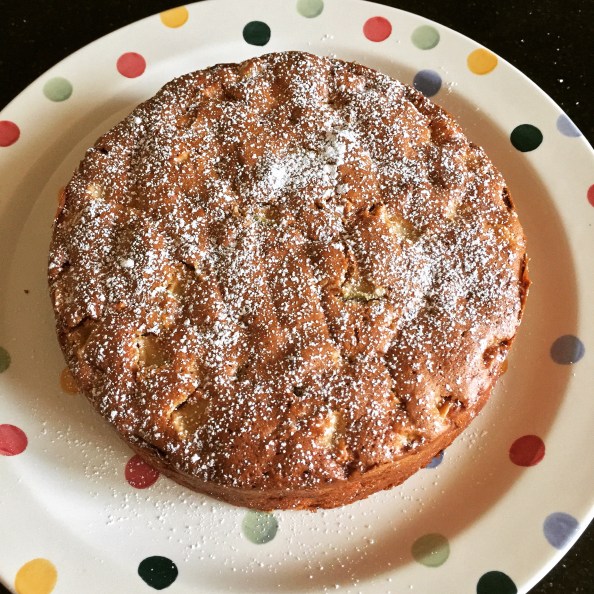
I hope it’s still correct to say apples are in season, because it’s already a couple of weeks since I made this apple cake with autumn in mind and only now am I getting round to writing about it.  On the other hand, it’s not exactly a seasonal cake because we all cook with apples throughout the year and to make this cake I bought Bramley apples from the supermarket.

Regular readers will remember that I like making apple cakes and prefer them to pies and crumbles, partly because they work both as puddings (with whipped cream, say) and as teatime cakes.

You can’t have two many apple cake recipes in your repertoire, in my view, and I’m happy to add this Delia recipe to mine.  The lazy baker in me particularly appreciated the fact that peeling the Bramleys is optional.  That was a no brainer: I didn’t peel them.

To make the job even simpler I used the all-in-one method to mix all the ingredients together before folding in the apples and orange zest.

Ingredients

  • 225g self-raising flour
  • 1 rounded teaspoon baking powder
  • 1 tsp mixed spice
  • 1/2 tsp cinnamon
  • 3 Bramley apples
  • 175g soft light brown sugar
  • 2 large eggs
  • 75g butter, softened
  • Grated zest of an orange
  • 1 tbsp milk (if needed)
  • A little icing sugar

Method

  • Conventional oven: pre-heat to 180ºC
  • Grease and base-line a 20cm loose bottomed cake tin
  • Sift the flour, baking powder and spices into your mixing bowl and add the butter, sugar and eggs
  • Beat until thoroughly blended.  I used my KitchenAid.  You could use an electric hand whisk
  • Chop the apples into small dice (with or without peel, remember) and fold into the mixture with the orange zest.  Add a little milk if the mixture seems dry
  • Spoon the mixture into your prepared tin
  • Bake in the baking oven of your Aga (or in the centre of a conventional oven at 180ºC) for about 1 hour, but do check on it every 10 minutes or so after the first half hour.  I put a piece of greaseproof paper loosely on top at this point because my cake was looking a little dark
  • The cake is done when it feels springy to touch and is starting to shrink away from the sides of the tin
  • Cool in the tin for 10 minutes or so before turning out onto a rack
  • Sprinkle with icing sugar to serve


Plum Torte


When I posted a photo of this to Instagram yesterday I called it plum cake but it’s officially a torte and with just the two eggs, it is definitely a little less cake-y than most cakes.

Anyway, I recommend the recipe to you.  I bought a whole load of Victoria plums on Friday with the vague intention of doing a seasonal weekend bake but with no specific recipe in mind.  I couldn’t find the Diana Henry recipe I thought I had in one of her books so I Googled “Diana Henry plum cake” and this was the result.  The observant among you will notice it uses purple plums, but I saw no reason to let that put me off and brazenly set to work with my pinkish yellow Victoria ones.

I do hope it’s fine to post the recipe here.

Ingredients

  • 125g plain flour
  • 1tsp baking powder
  • pinch of salt
  • 115g butter, softened
  • 200g soft light brown sugar
  • 2 large eggs
  • 1 tsp vanilla extract
  • about 9 plums, halved and stoned
  • 1 tbsp granulated sugar
  • 2 tsp lemon juice

Method

(Preheat conventional oven to 180ºC)

You will need a 23cm springform tin.  Not sure why but Henry says ungreased.  I obeyed and it came out fine.

Don’t forget the sugar and lemon juice topping; I haven’t tried it without but have a feeling it makes all the difference, to both taste and texture.

  • Henry doesn’t, but I used the all-in-one method and placed all the ingredients except for the plums, granulated sugar and lemon juice in the bowl of my KitchenAid and mixed at high speed for about 2 minutes until thoroughly blended.
  • Spoon the mixture into your tin and place the plums, skin-side up, on top.
  • Sprinkle the granulated sugar and lemon juice over the cake and bake (in the Aga baking oven).  Takes about 45 minutes, in a conventional oven or the Aga.
  • The cake is done when it starts to come away from the sides of the tin and a skewer inserted into the middle comes out clean.
  • Leave it to cool for 20 minutes on a rack and then release from the tin.  Be careful: it’s quite fragile and the plums have probably sunk to the bottom but this doesn’t matter at all.
  • We ate it at room temperature but it would have been just as delicious slightly warm.


Summer “Cooking”

Maybe I’m just making excuses to be lazy but the summer weather means I haven’t felt much like baking or cooking recently.  It hasn’t even been consistently hot and sunny but here in Bristol, even on the wet, grey days, it’s been muggy: not the sort of weather conducive to standing next to a hot oven for a few hours.

The solution is either to get your husband to barbecue or to prepare salads and light dishes requiring minimal cooking time.  I have managed to achieve both of these and thought I’d share with you some of the recipes we’ve enjoyed.

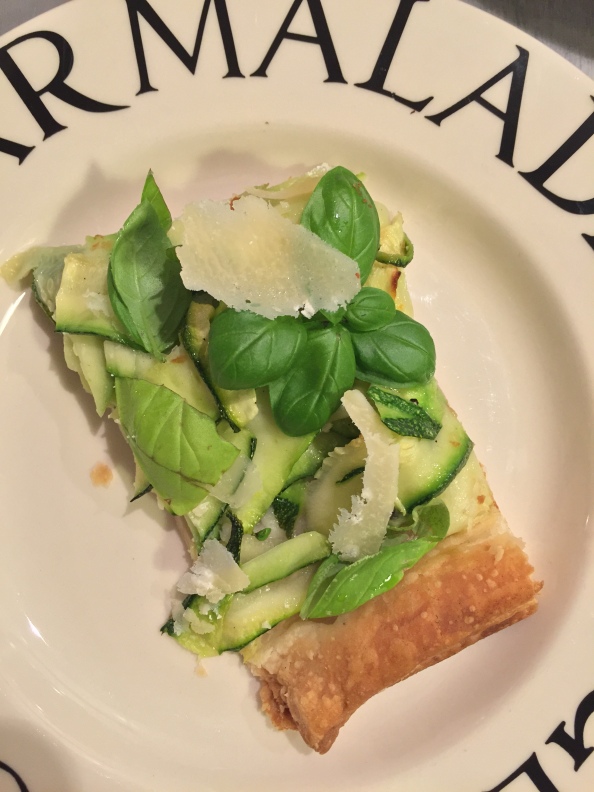
First up, this courgette tart, which was an excellent way of using up some superb homegrown courgettes a friend had given us.  The recipe is by Rose Prince and appeared in the Saturday Telegraph magazine a couple of weeks ago.  You will see that she recommends making your own rough puff pastry but I went for second best and used shop bought pure butter puff pastry.  I was not that successful at getting my courgettes to form “ribbons” but it didn’t matter that much.
IMG_3628

Next, burgers.  This was a very last minute supper.  It was a lovely warm evening and so we shelved our original supper plans and youngest son popped to Waitrose to buy some ground beef (not too lean) and burger buns.  All I do to make burgers is add ground black pepper and an egg, mix well and shape.  I don’t add onion or salt or garlic.  This way you can really taste the beef and get additional flavours from the sauces and other toppings you serve alongside (eg gherkins, ketchup, bbq sauce, mustard, cheese, lettuce, sliced tomatoes).  Sometimes we sandwich our burgers in ciabatta but, to be honest, the regular burger buns with sesame seeds work perfectly.  On this occasion, in addition to the toppings listed above, I found some red Romano peppers in the fridge which I halved, deseeded, drizzled with olive oil and sprinkled with salt for my husband to grill on the barbecue.  J invited his friend round to join us and by the time we were ready to eat it was nearly dark so we lit some candles and tucked in.  Impromptu evenings like this are very often the most enjoyable.

Once again, my latest favourite cookbook, Honey and Co., came up trumps when I wanted a simple fish recipe the other Friday.  The recipe in the book used sea bream but I could only get sea bass fillets; I doubt there’s much difference.  I just roasted the fish fillets (one each) in the Aga roasting oven for 8-9 minutes with a little olive oil and seasoning and squirted on some lemon juice at the end.  The salad ingredients are as follows (for 4 people):

  • 4 small Lebanese cucumbers or 1 long one
  • 250g red grapes
  • 4 sprigs fresh mint, leaves picked and chopped
  • 1 small bunch dill, fronds picked and chopped
  • Juice of half a lemon
  • 1 tsp salt
  • Ground black pepper
  • 3 tbsp extra virgin olive oil
  • 200g pain yoghurt (I used Greek style)

Peel the cucumber to create a zebra-striped effect, slice in half lengthways and use a teaspoon to scoop out the seeds.  Chop into crescents and place in a large bowl.  Wash and halve the grapes and add with the chopped herbs.  Season with the lemon juice, salt, pepper and olive oil and mix well.  Spread two tablespoons of yoghurt on each plate and pile some salad on top, ready for the fish when it’s cooked.  Et voilà.

Salade Niçoise

Salade Niçoise is one of my favourite summer salads.  On summer holidays in France I would always order it.  But what is it exactly?

Last weekend I decided to make it when my son W and his fiancée were home, but realised I’d never used a recipe and always just made it up as I went along.  Browsing some of my cookery books, magazine cuttings and Google, I realised that there were many different versions of this salad.  I consulted Twitter too: there were as many people declaring potatoes were definitely not to be added as there were those who insisted on them.  What to do?  The wonderful Felicity Cloake had of course done the research in this article in her “How to make the perfect” series, but her “perfect” recipe was not my perfect one.  In reading about the salad, I was surprised at how many chefs, including Felicity, did not include tuna.  For me, this salad is one of the best vehicles for tinned tuna.  I was also surprised that green beans were not a regular addition.  I liked the raw broad bean idea but it would be more time consuming for this fairly lazy cook.  (I also didn’t skin or deseed my tomatoes: what of it?)

In conclusion, there doesn’t seem to be a an agreed upon, universal recipe for Salade Niçoise but what does it matter?  Make a salad with the the ingredients you like and which you have to hand.  On this particular occasion, mine was made with new potatoes which I added to the vinaigrette (some say mustard is a no no but I’m not one of them) while still warm, green beans, cooked and refreshed in cold water, tomatoes, tinned tuna, black olives, anchovies (essential) and hard boiled eggs.  I also added cucumber but this was a mistake: too watery.  It may not have been authentic, but with crusty ciabatta to mop up the dressing, it made for a delicious Saturday lunch.  And next time I make it, it might well be completely different.


A No Aga Day

There is nothing sadder than an Aga which isn’t on.  Today my Aga has been cold and consequently – I know it’s silly, especially since it’s summer, allegedly – my kitchen seemed a rather uninviting place.  The Aga was turned off last night to give it a chance to cool down before its annual service today.  It’s just been switched back on and with a bit of luck will have enough heat for me to cook supper on it tonight.

Some Aga owners (sensibly) turn theirs off during the summer months and use their alternative oven.  The trouble is, I don’t have an alternative oven.  It was a deliberate decision when we had the Aga installed in our new kitchen ten years ago to be a full-time Aga cook and also not to use up space unnecessarily; instead, I have plenty of cupboards!  Admittedly it can feel too hot if ever we have a spell of proper summer weather (ie not often) but our Victorian house has large sash windows which can be opened wide, and also, the Aga can be turned down and still be used.

It’s a pity the Aga service hasn’t coincided with some really hot weather like we had a couple of weeks ago, when it would have been a relief to have a cooler kitchen. It’s grey and wet out there but mild: it’s definitely summer rain we’re experiencing.

Still, it doesn’t mean I can’t tell you a little about what I’ve been making in the kitchen lately.  It’s the season for salad and soft fruit, neither of which necessarily requires cooking.

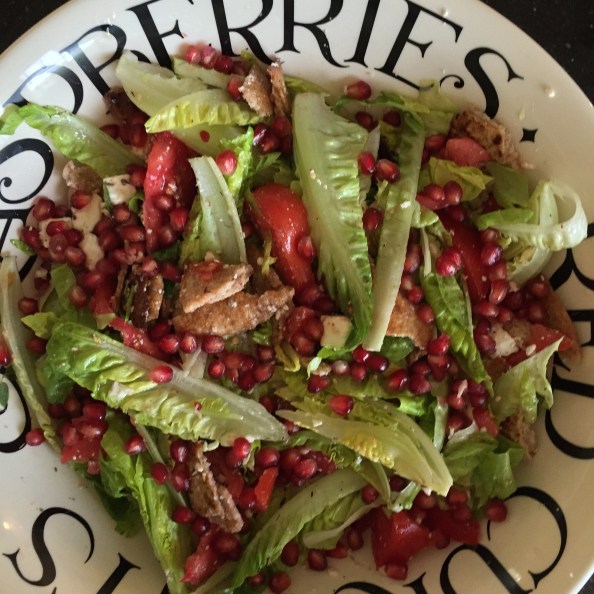
A delicious salad in my new favourite book, Honey and Co., is fatoush.  As far as I can tell, there exist many versions of it, but this is the first one I’ve come across which includes pomegranate.  If I was making it today I’d have to add the pitta without toasting it, because I don’t have an electric toaster.

Fatoush

Ingredients

  • 1 pitta, cut in half to make two thin pieces
  • olive oil
  • 1 head of Little Gem lettuce
  • 250g mixed tomatoes
  • 150g feta
  • 2 sprigs of fresh oregano, leaves picked (if you don’t have any fresh, use a little dried oregano in the dressing)
  • 2 tsp za’atar
  • 2 heaped tbsp fresh pomegranate seeds

Dressing

  • 1 clove garlic
  • 2 tbsp extra virgin olive oil
  • 1 tbsp red wine vinegar
  • 1/4 tsp sea salt
  • a little freshly ground black pepper

Method

  • Peel the garlic, place it on a chopping board and press down on it with the back of a knife until it’s crushed but still in one piece.  Mix it together with the other dressing ingredients in the bowl you want to serve the salad in, and leave to infuse for about an hour at room temperature
  • Brush the pitta pieces with a little oil, place them on a baking tray at the top of the roasting oven for a few minutes until they’re golden and crisp.  You can do this under a grill or in a regular toaster too.  Break into bite-size pieces
  • Separate the lettuce into leaves and cut these into strips
  • Cut the tomatoes in two or three different ways (slices, wedges, chunks) to give the salad some texture.  Crumble the feta but not too much
  • When you are ready to serve, remove the garlic clove from the dressing (it was only there to add a hint of flavour) and add all the salad ingredients to the bowl and toss them gently together

IMG_3074


At the 21st birthday party we went to recently, our hostess served this strawberry dessert which was absolutely delicious.  This is not a precise recipe; I’ll leave you to adjust quantities to your liking.

Strawberries in Balsamic Vinegar with a Mascarpaone, Fromage Frais and Vanilla Cream

  • Hull and halve or quarter your strawberries, depending on size, and place in a bowl with some sugar and balsamic vinegar.  I used a couple of tablespoons of balsamic and just a sprinkling of caster sugar for about 600g strawberries.  Leave these to infuse for a couple of hours.
  • Serve with the cream made up of 50% mascarpone and 50% fat free fromage frais, and a little vanilla extract and some caster sugar to taste
  • Serve the strawberries in individual bowls with large dollops of the cream on top

Apologies for not having a photo of this dessert but here are some strawberries anyway.


freegreatpicture-com-2848-high-definition-material-strawberry

Baking with Raspberries


I don’t see myself as much of a maker of puddings or desserts; I’m nervous about pastry and anyway, during the week there simply isn’t time to make a dessert.  In all honesty I’d rather bake a cake to have with a cup of tea in the afternoon and then just eat some chocolate to satisfy my sweet tooth at the end of a meal.  But, as I wrote here, I’m not eating chocolate anymore.

On Sundays, as I think I’ve mentioned before, my mother-in-law usually makes a pudding for us all.  I’ll make one if we have friends round or to take to friends if we’re invited to lunch or supper.  I’ll also make a dessert when it’s my turn to host book club or film club.

Raspberry and Cinnamon Torte

The raspberry and cinnamon torte I wrote about in my tumblr days is one of our favourites:

Bakewell Cake

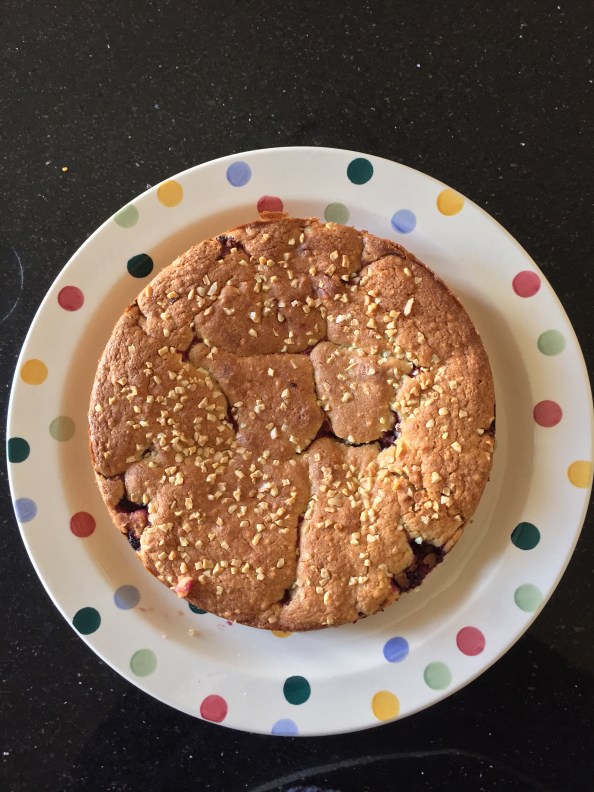
This bakewell cake by Fay Ripley, which my Twitter friend @lesleyj28 alerted me to recently, could serve as a dessert or a teatime cake.  I pounced on the recipe because it contains everything that’s delicious and good about a bakewell tart (almonds, raspberry jam!) but no pastry.  I love pastry but (see above) don’t love making it.  Without the need to make pastry, this cake is mixed and baked in no time.  I used to watch Fay Ripley in Cold Feet on the telly (LOVED it) and had heard about her recipes but had not tried them before.  As I began to make this, I realised how similar it is to my torte.  It is a little more “cake-y” (two eggs instead of one), has jam in it and doesn’t contain cinnamon but apart from that it’s the same.  In fact, if I made it again, I’d probably replace the vanilla extract with cinnamon, but that’s just my personal preference.  Also – a small point – I didn’t have any flaked almonds in the cupboard so scattered over chopped almonds instead: a poor compromise on Fay’s recipe, we later all agreed.

Ingredients

  • 150g butter, softened
  • 150g golden caster sugar
  • 150g SR flour
  • 150g ground almonds
  • 2 large eggs
  • 1 tsp vanilla extract
  • 6 tsp raspberry jam
  • 150g raspberries (I used frozen because it was all I had)
  • 50g flaked almonds

Method

  • Grease a 22cm springform tin and base-line with bake-o-glide or baking parchment
  • In a mixer, food processor or with an electric hand whisk combine the butter, sugar, flour, almonds, eggs and vanilla extract (oh how I love the all-in-one method!)
  • Place half the mixture in the cake tin, smoothing it out, and dot the raspberry jam over, half a teaspoon at a time.  Scatter the raspberries over
  • Drop spoonfuls of the remaining mixture over the fruit but don’t worry if there are gaps; it will spread in the oven
  • Scatter over the flaked almonds
  • Bake for about 40 minutes in the Aga baking oven (or a little longer in a conventional oven at 180ºc).  Not easy to test this cake with a skewer because the raspberries make it a little wet in the middle.  It should be golden brown and springy to touch when done

Couldn’t be simpler.


IMG_2705


Raspberry Muffins

I love making raspberry muffins too, although I see them as more of a coffee or teatime thing than a dessert.  I also wrote about these on my tumblr:

Cavolo Nero

4f3d21f62542b_cavolo_nero


Cavolo nero is a cousin of kale and both belong to the brassica family.  Its long leaves are so dark green in colour, they’re nearly black or “nero”.  It originates from Tuscany where it was first believed to be grown in 600BC.

I can’t say when it first started to appear in our greengroceries and supermarkets but it doesn’t seem like long ago.  Since I first discovered it, relatively recently, I’ve used it mainly in minestrone and in pasta dishes.  It has a deliciously rich and intense flavour.

Not surprisingly, cavolo nero works well in pasta dishes and this recipe by Stevie Parle, which appeared in the Telegraph a couple of years ago, is delicious.

Ingredients

  • 500g penne
  • 300g cavolo nero (you can strip the leaves from the stem if you like but since it’s going to be puréed I don’t think it’s necessary. I just chopped mine up.)
  • 2 garlic cloves, peeled
  • 3 tbsp pine nuts, lightly toasted
  • 150ml extra virgin olive oil
  • Grated parmesan to taste

Method

  • Bring some salted water to the boil with the garlic cloves in a large saucepan and add the cavolo nero.  Cook for 5-10 minutes until tender and drain, keeping the garlic cloves
  • Transfer this and the pine nuts to a food processor and blitz.  Add the olive oil and parmesan (maybe a couple of handfuls), process again and season.  You will have a dark green sauce
  • Meanwhile bring another pan of water to the boil and cook the penne according to packet instructions
  • Drain the pasta, reserving a ladleful of the cooking water, return it to the pan and toss with the sauce, loosening it with some of the cooking water
  • Finish with a drizzle of olive oil and serve with more grated parmesan


Fricassée of Chicken with Tarragon


IMG_4660

This morning I tweeted a line I’d read in the Sunday Times about the Sunday roast being on its way out but that this wasn’t the case in my house.  Wonderfully, the replies I received confirmed that my family is not the exception.  It doesn’t have to be eaten at lunchtime (everyone’s Sundays are busy) but I believe it’s a ritual and tradition worth preserving.

When I was a student and sharing a flat with three friends, where cooking was concerned we had the typical student repertoire of the era, comprising 1001 things to do with mince. But believe it or not, one of our staples was also chicken fricassée.  I’m afraid I can’t remember the recipe in detail but it wasn’t like the dish I made for Sunday lunch today. Our student recipe involved sautéeing pieces of chicken and mushrooms and then adding a little flour, stock and milk (and possibly some cream) to make a white sauce.  We used to serve it with rice.

The origin of the term “fricassée” is French, possibly from “frire” (to fry) and “casser” (to break in pieces), which might explain why all the fricassée recipes I found in a quick Google search this afternoon used chicken pieces rather than a whole bird.  The one I made for lunch today, based on this recipe by Michel Roux which I read in the Times during the week, is the only one I’ve seen which involves roasting a whole chicken.  (Apologies if you’re not a Times subscriber and the article is behind the paywall.)

Anyway, we really enjoyed it; the tarragon sauce is delicious.  Sometimes it’s good to return to a simple classic.  We don’t need always to be finding the next fashionable thing to cook.

I made changes to the Roux recipe; very brave of me, I thought, considering his chef’s credentials and renown, but I honestly didn’t think we needed quite that much cream and also, when you have a roasting oven as hot as the Aga’s, why would you need to brown the chicken before putting it in the oven?

Ingredients

  • 1 whole chicken (mine weighed 2kg)
  • Butter
  • 3 shallots
  • Tarragon vinegar (I didn’t have any so used good quality white wine vinegar)
  • About 100ml white wine
  • About 100ml chicken stock
  • About 150ml double cream
  • Handful of tarragon leaves (adjust amount according to your preference)

Method

  • Place the chicken in a roasting tin, spread butter all over it and season.
  • Roast in the roasting oven for about 1 hour and 20 minutes, basting a couple of times during cooking.  I placed mine on the rack on the third set of rungs for the first 20 minutes, then moved the rack to the bottom of the oven with the tin on the fourth set of rungs.  The cooking time will obviously depend on the weight of your chicken.
  • Remove the chicken, place on a dish and leave to rest (perhaps on the warming plate of your Aga)
  • Pour off most of the fat, add a knob of butter and sweat the shallots gently for about 5 minutes.  Add 1tbsp vinegar and the white wine and let it bubble up for a few minutes.  At this stage I poured everything into a small saucepan: easier than continuing in the roasting tin.
  • Add the chicken stock and boil until reduced a little.  Add the cream and repeat.  Check for seasoning.  Add the tarragon leaves at the last minute.  Pour into a jug for serving.  We ate our fricassée with new potatoes, broccoli and carrots.


Simnel Cake

Simnel Cake

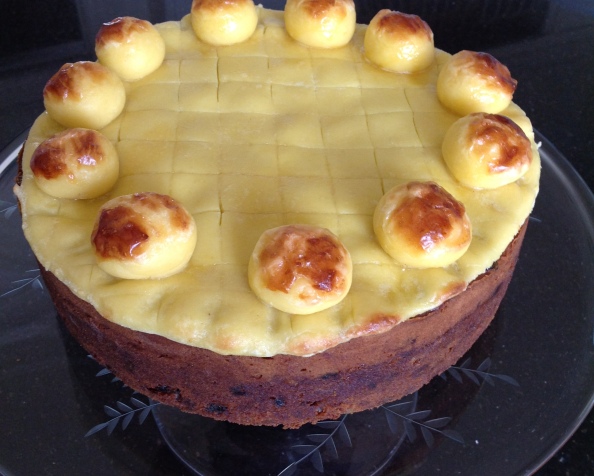
Why not make this delicious fruit cake for Easter? As you probably know, simnel cake was originally baked for Mothering Sunday in the middle of Lent; girls in service would make one to take home to their mothers. I love it because it’s a fruit cake and lends itself to being baked slowly in the Aga, which makes for a very moist cake. Then there’s the marzipan which I adore almost as much as chocolate, and that’s saying something.

Last year my son’s lovely girlfriend made us a simnel cake, so we had two. No-one was complaining. The only problem for me was that she raised the bar and made her own marzipan, and now my youngest son says he doesn’t like shop-bought marzipan at all and suggested I make mine too. It really isn’t difficult and actually doesn’t take very long if you have a food processor.

Marzipan

This will make more than you need for the cake but I adore marzipan and was happy to have some left over. Disclosure: marzipan quantities given here are approximate. The balls on top can be as big or small as you like. The top circle can be as thick as you like. If you don’t want to make your own, I suggest you buy a 450g packet of marzipan.

  • 450g icing sugar
  • 450g ground almonds
  • 2 eggs
  • 1 1/2 tsps brandy
  • Juice of a lemon
  • 1/2 tsp almond extract
  • Simply  blitz all the ingredients in a food processor until it’s come together nicely
  • Tip this out onto a dusting of icing sugar on your worktop and knead it for a bit
  • Flatten it slightly, wrap it in clingfilm and put it in the fridge until you’re ready to use it

Simnel Cake

I used a Mary Berry recipe except that instead of placing a circle of marzipan in the middle of the cake, I folded small pieces of it into the mixture, à la Delia’s recipe.

Ingredients

  • 100g natural glacé cherries
  • 225g softened butter
  • 225g light muscovado sugar
  • 4 large eggs
  • 225g self-raising flour
  • 225g sultanas
  • 100g currants
  • 50g chopped candied peel
  • Zest of a lemon (MB says 2 lemons, but I didn’t want it too lemony)
  • 2 level tsps mixed spice
  • 200g marzipan, cut into small squares or rolled into balls and tossed in a little flour

Topping

  • 225g marzipan
  • 2 tablespoons of apricot jam
  • 1 large egg, beaten, to glaze

Method

  • Pre-heat a conventional oven to150ºC/Fan 130ºC/Gas 2
  • Grease a 20cm deep round cake tin, then line the base and sides with baking parchment or bake-o-glide
  • Put the cherries in a sieve, rinse under running water, drain and dry on kitchen paper. Cut into quarters
  • Measure all the cake ingredients into a large mixing bowl, except for the fruit and marzipan, and beat well until thoroughly blended. (I used my KitchenAid)
  • Fold the fruit into this mixture and then finally the pieces of marzipan
  • Spoon the mixture into your prepared tin and level the surface
  • Bake in a conventional oven for about 2.5 hours or the Aga simmering oven for 4-5 hours. This really depends on your Aga. The important thing is the cake is coming away from the sides a little, is well risen, evenly brown and firm to the touch
  • Leave to cool in the tin for 15-30 minutes
  • When the cake is completely cool, brush the top with a little warmed apricot jam and roll out marzipan to make a circle to fit the top. Press firmly on the top and crimp the edges to decorate. (You will see from my photos I made a bad job of this. You will do better.)
  • Mark a criss-cross pattern on the marzipan with a sharp knife. Form the remaining marzipan into 11 balls (representing the apostles minus Judas)
  • Brush the almond paste with beaten egg and arrange the balls around the edge of the cake
  • Brush the tops of the balls with beaten egg and then place the cake in the roasting oven (or under the grill) for 3 or 4 minutes, near the top, to turn the marzipan golden


Casseroles

IMG_2078


Spring was definitely in the air last weekend.  It was still chilly, especially in the early morning and evening, but when the sun was shining one could actually feel the heat from it.  Early Spring blossom has started to appear on the trees in Bristol and the daffodils are very much in flower.  So it might seem odd that I chose to cook rather wintry, comfort food dishes, but I thought I’d better get them in before temperatures really do rise.


Lancashire Hotpot

My husband says I can’t possibly write a post about this meal because we didn’t take a photo of it, but, with apologies for the lack of illustration, I’ve decided to do it anyway.  It was a success and the ideal thing to cook last Saturday when I had plenty of time in the morning but wanted to watch England play Wales in a crucial Six Nations rugby match in the afternoon.  Honestly, as you will see, this hotpot is more or less just an assembly job.  While I was preparing it I managed to keep an eye on the Italy v Ireland match.

For the ingredients, I more or less followed Felicity Cloake again and make no apologies for that.  Here is what I did.

Ingredients

(Serves 4)

  • 6 lamb cutlets
  • 400g diced lamb shoulder
  • Flour, salt and pepper
  • 3-4 large, floury potatoes
  • 2 sprigs thyme
  • 2 onions, sliced
  • 1 bay leaf
  • 300ml stock (Felicity says lamb stock, but I used a homemade chicken one because that’s what I had in the fridge, and it was fine.)
  • 20g melted butter, plus extra to grease.

Method

  • Dust the meat with the flour and seasoning.  Peel and slice the potatoes thinly.
  • Butter a casserole which has a lid.
  • Put a layer of overlapping potato slices in the bottom of the casserole, season them and sprinkle with a little thyme.
  • Put the meat and bay leaf on top, followed by the onions and some more seasoning.
  • Top with the remaining potatoes, overlapping them again.  Season these and pour on the stock, which should not come above the topping.
  • Brush the potatoes with the melted butter.
  • Put the lid on and place the casserole in the simmering oven.  Cook for 4-6 hours.
  • Thirty minutes before serving, remove the lid and transfer to the roasting oven to brown the potatoes.

I placed it in the oven at about 2pm and then all I had to do when we were ready to eat was steam some carrots (in the simmering oven of course) and cook some cabbage.


IMG_2565


By the way, for afternoon tea on the sofa, in front of the England v Wales match, we had buttered slices of this delicious “hot cross” fruit loaf which I’d bought in the morning from the Bordeaux Quay stall at Whiteladies Road Market.


Simple Stroganoff

This beef stroganoff, based on Delia Smith’s recipe, has the flavours of “proper” stroganoff but the advantage that it can be made ahead instead of at the last minute; it’s ideally suited to Aga cooking.

Ingredients

(Serves 4 people)

  • 700g fairly lean braising beef
  • 2 onions, sliced
  • 50g butter
  • 275 ml dry white wine
  • 250g mushrooms, sliced if large
  • 250ml sour cream
  • Freshly grated nutmeg
  • Salt and freshly milled black pepper

Method

  • Cut the meat into thin strips, about 5mm wide and no more than 6cm long.
  • Melt the butter in a casserole and soften the onion in it in the simmering oven for about 15 minutes.  Remove to a plate with a slotted spoon.
  • Place the casserole on the boiling plate and brown the beef in batches.
  • Once the meat is browned, move the casserole to the simmering plate and return the beef and onion to it.  Season and pour in the wine.
  • Bring to simmering point, put on the lid and let it cook in the simmering oven for 3-4 hours.
  • An hour before you want to eat, stir in the mushrooms, cover and return it to the oven.
  • Taste to check seasoning, stir in the sour cream with a good grating of nutmeg.  Don’t let the cream boil.
  • Serve with plain boiled rice and perhaps some broccoli or a green salad.

Depending on the weather, perhaps my next posts will move on to lighter, fresher dishes.

Paella

Paella might be my favourite dish.  For me it’s one of the most delicious things you can eat.

It’s made all year round but changes with the seasons.  I wonder if it’s one of those dishes like ragù in Italy where there are as many recipes for it as there are cooks.  Felicity Cloake quotes Valencian chef (Valencia being where paella originated) Llorenç Millo as saying that there are as many recipes as there are villages.

We  haven’t had a holiday in Spain for many years but we used to go to Nerja to stay in a friend’s appartment.  It was within easy walking distance of the beach along which there were several great restaurants.  Our favourite was the one where a man made paella over an open fire in the biggest paella dish you’ve ever seen.  The first time I saw this I watched him, enthralled, as he gradually added all the elements.  By the time he’d finished quite a crowd had gathered round to watch and then, finally, to eat.

He used to make what I consider to be be a traditional paella comprising chicken and seafood, but apparently paella didn’t start out as a fish or seafood dish at all.  Over the years I’ve made various permutations, the latest being this haddock one, based on a recipe by Tamasin Day-Lewis.  Hers used monkfish but there was none available when I was shopping and the haddock loin was a good alternative, in my view; I’m sure any firm white fish would work.  I’ve read that paella always contains some sort of pig meat (bacon, chorizo or pork) but I don’t think it’s essential.  My haddock one doesn’t and in fact I don’t remember the beach one containing any either.   Perhaps in future posts I’ll give you the recipe for my chicken and chorizo paella or Ottolenghi’s vegetable one, which is quite superb.  And I really ought to try Felicity Cloake’s “perfect” paella too.

You don’t have to have a paella pan.  I’m thrilled with the one pictured, a recent purchase, but before I had it, I used either a large, deepish frying pan or a wide but shallow casserole.

Paella with haddock, saffron and peppers

Serves 4

  • 5 tbsp olive oil
  • 500g haddock loin, skinned and cut into 2-3cm cubes
  • 2 onions, finely chopped
  • 2 green peppers, halved, seeded and finely chopped
  • 4 cloves of garlic, crushed
  • 1/2 tsp fennel seeds
  • 500ml (approx) of good quality fish stock (I bought mine)
  • a good pinch of saffron
  • 225g bomba (sometimes called Calasparra) rice
  • A glass of white wine or fino sherry
  • 1 small bunch flat-leaf parsley, finely chopped
  • 1/2 tsp sweet smoked paprika
  • salt and pepper
  • About 200g mussels, prawns or squid or if you prefer, any combination of these. I used a packet of frozen, cooked mixed seafood, defrosted first.
  • 225g piquillo peppers, torn in strips

IMG_2563


  • Heat 2 tablespoons of the oil in your pan on the simmering plate.  Add the haddock and stir-fry for a couple of minutes until slightly underdone.
  • Tip the fish into a dish with its juices, wipe the pan clean with kitchen paper and return to the simmering plate.  Add the remaining oil and then the onion and green pepper.  Give them a stir, coating everything in the oil and move to the simmering oven to cook for about 20 minutes until soft, adding the garlic and fennel for the last 5 minutes or so.
  • Meanwhile bring the stock to the boil in a saucepan on the boiling plate and infuse the saffron in it off the heat.
  • Add the rice to the paella pan on the simmering plate and stir to ensure every grain is coated in the oil.
  • Add the wine or sherry, followed by most but not all of the saffron-infused stock, half the parsley and the paprika and season with salt and pepper.  Do not stir from this point.
  • Once this is simmering, place it either near the bottom of the baking oven or in the simmering oven, uncovered, until there is very little liquid left.  Difficult to give precise timings because I find it varies (and as you know, timings are not usually crucial in an Aga) but maybe 30 minutes in the baking oven and 15 in the simmering oven.  If it looks dry and the rice is still not tender, add the rest of the stock.
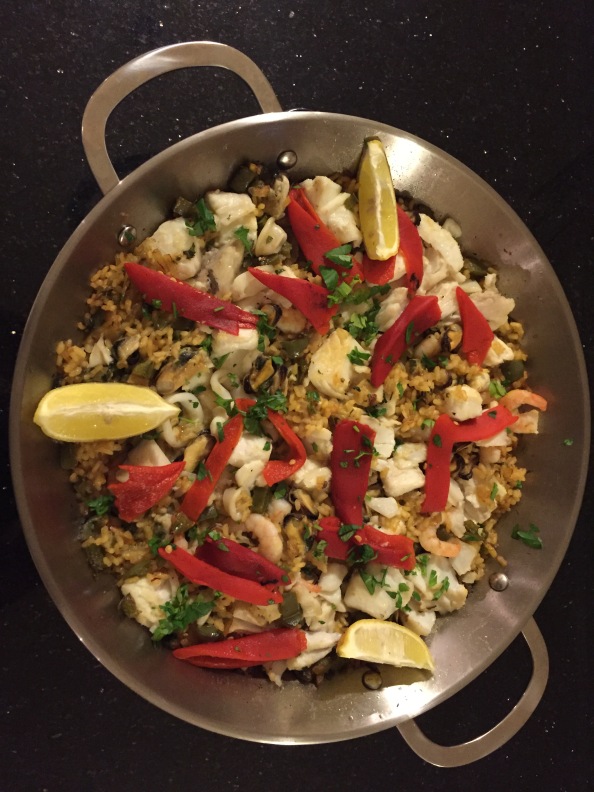
  • When there’s still a little liquid left above the rice add the fish and seafood, pushing it down into the stock and return to the simmering oven until heated through.  It wouldn’t do any harm to leave it for half an hour like this, if you’re not quite ready to eat, but try not to leave it too long if you’ve added prawns, because they go tough and rubbery when overcooked.  Place the strips of piquillo peppers on top.
  • Let the rice sit for a few minutes on the warming plate before serving.  Finally, decorate with lemon wedges and the remaining chopped parsley.


IMG_4532

Paella with haddock and saffron