Chicken and Sweet Potatoes with Miso, Ginger and Spring Onions

Chicken and Sweet Potatoes with Miso, Ginger and Spring Onions


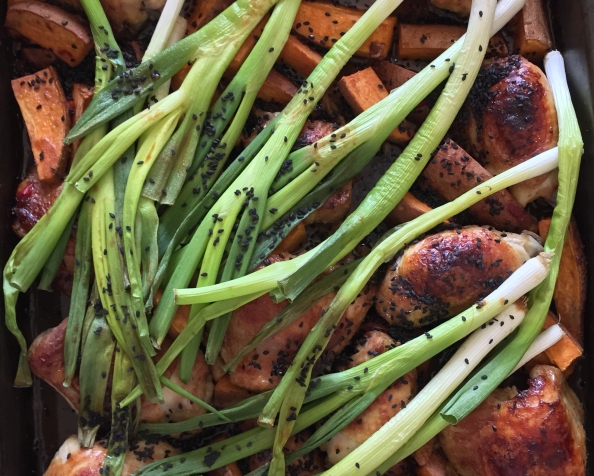
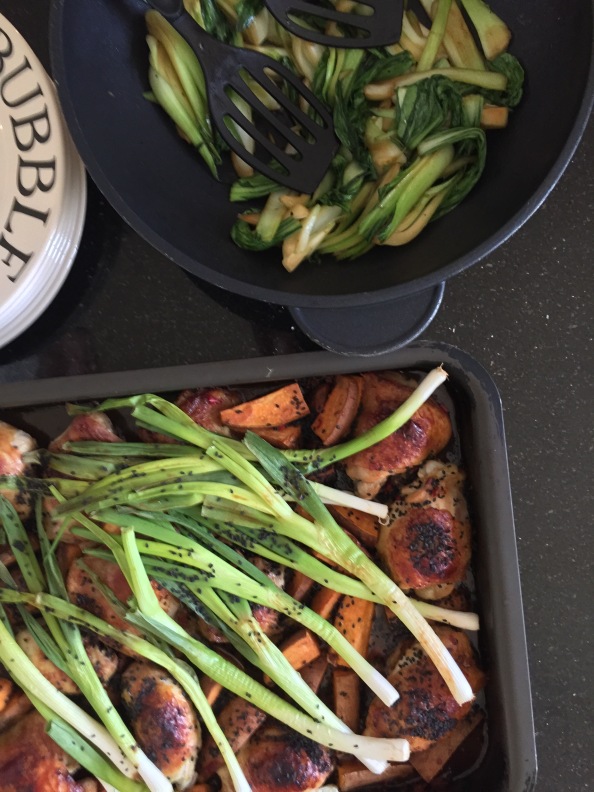
Another of my Easter weekend dishes was this simple chicken traybake, which is also a Diana Henry recipe. It appeared in the Telegraph’s Stella magazine a few weeks ago. I tried it then and knew my family would like it. It’s perfectly suited to Aga cooking.

Ingredients

For 4-6 people, depending on hunger levels and the size of the chicken thighs

  • 8 chicken thighs
  • 700g sweet potatoes, washed and cut into wedges
  • 2½ tbsp white miso
  • 1 ½ tbsp honey or maple syrup
  • 2 tbsp rice wine
  • 1 tbsp dark soy sauce
  • 2.5cm chunk ginger root, peeled and grated or finely chopped
  • 3 cloves garlic, crushed
  • 1 red chilli, halved and finely chopped (use the seeds for extra heat)
  • 12-18 spring onions
  • 3 tsp black or toasted white sesame seeds (or a mixture of the two)

For the final basting

  • 1 tbsp white miso
  • 1 tbsp honey or maple syrup
  • ½ tbsp dark soy sauce
  • ½ tbsp rice wine

Method

Pre-heat conventional oven to 190ºC/gas mark 5

  • Place the thighs in a large roasting tin with the sweet potato wedges (they should be able to lie in a single layer)
  • Mix together everything else except the spring onions and sesame seeds. Pour this over the chicken and sweet potatoes, turning everything over so the ingredients are well coated, finishing with the chicken skin-side up
  • Roast for 45 minutes at the top of the roasting oven, basting every so often, and turning the wedges over
  • Mix the final basting ingredients together and about 15 minutes before the end of cooking time, take the tin out of the oven and pour them over, adding the spring onions at the same time. They should become soft and slightly charred
  • When cooked, sprinkle with the sesame seeds and serve
  • I served ours with pak choi stir-fried in a little groundnut oil with black pepper and soy sauce

IMG_4483


Slow-Cooked Chicken

img_4353

A friend came to supper the other day who said he had exactly the same Aga as mine. He confessed he didn’t think he and his wife made the best use of theirs and proceeded to ask me some questions. I was surprised to find they didn’t even know what the ovens were for: they only used the roasting and baking ovens (although they didn’t know this is what they’re called) and the simmering oven for warming plates. They didn’t use the warming oven at all! I told him they needed to buy an Aga book and that I’d read my Mary Berry one, which came free with my Aga, from cover to cover. He said they had the book but hadn’t bothered to read it.  In their defence, they “inherited” their Aga when moving into their house whereas I made a deliberate choice to become an Aga owner and cook and saw it as a kind of project. It made me realise there are people out there who didn’t choose to have an Aga but have got one by default and that they might find blogs like mine useful.

I was sorry therefore that the supper I cooked for our friend and his parents, old friends of my husband’s family, was not one of my best. I wanted to use up the pheasant breasts I still had in my freezer and found this recipe. It looked and smelled delicious and tasted good, but the meat was a little rubbery and dry. I find this happens with chicken breasts too and I don’t know what the answer is. What is more, I chose the recipe because it was a slow braise, which in my opinion ought to have ensured tender, succulent meat. On reflection, I think breasts, whether of the pheasant or chicken variety, should not be cooked for very long, so my suggestion for adapting this recipe for the Aga would be only to cook it (in the simmering oven of course) for the initial 45 minutes.

Legs and thighs, on the other hand, lend themselves to slower cooking. The dish in the photo above is braised chicken pappardelle. I got the recipe from Yotam Ottolenghi’s Guardian column, and you will see he provides two further slow-cooked chicken recipes. I pounced on the article when I saw it, as I always do when I see the words “slow-cooked”; I immediately think “Aga simmering oven”. I have now made all three recipes and they’re all superb, but today I’m going to tell you how I made the one above in the Aga.

Braised Chicken Pappardelle

Ingredients

  • 4 chicken legs (thighs and drumsticks)
  • 2 tbsp olive oil, plus extra to finish
  • Salt and black pepper
  • 3 carrots, cut into 1.5cm chunks
  • 1 large onion, peeled and finely chopped
  • 3 garlic cloves, peeled and crushed
  • 2 bay leaves
  • 5g thyme sprigs
  • 500g vegetable stock
  • 50g anchovies in oil, drained and finely chopped
  • 400g pappardelle (I used a good quality dried one)
  • 40g rocket leaves

Method

  • Put the chicken in a bowl and toss with the oil, a quarter teaspoon of salt and a generous grind of black pepper
  • Put a large, heavy-based casserole for which you have a lid on the simmering plate.  Sear the legs for ten minutes, turning them once, until the skin is dark golden brown, then remove from the pan.
  • Add the carrots, onion, bay leaves and thyme to the pan and cook until softened. You could do this in the simmering oven of course. Stir in the garlic and cook for a further minute
  • Return the chicken to the pan and add the stock, anchovies and a good grind of black pepper. Cover and cook in the simmering oven for at least an hour but two would be better
  • Lift out the chicken from the pot and bring everything to the boil on either the simmering or boiling plate and cook until the liquid is reduced to about 300ml
  • Meanwhile pull all the meat off the chicken bones in chunks or, as I prefer, shreds, and discard the bones and the thyme
  • Cook the pasta according to the packet instructions until al dente and drain
  • Add the chicken and pasta to the reduced sauce and vegetables and mix well
  • Divide between four plates or pasta bowls, layering with rocket leaves as you go
  • Drizzle with olive oil and serve

Aubergine and Pea Curry

singin-in-the-rain-7438_1

So that’s it for another year and we can get back to normal, whatever “normal” is. The tree has been taken down and is currently awaiting collection in our front garden; all the decorations have been stored away in the spare room cupboard; and Sons 1 and 2 have returned to work, in Cambridge and London respectively. It was so lovely to have them at home, sometimes with and sometimes without the girlfriend of one and  the fiancée of the other, and although I should be used to it, I always feel a little sad when they’ve gone; not too sad, mind, because, as my mother says, if your children are happy to leave home, then you have probably done a good job as a parent. Son 3 stayed on for an extra couple of days which softened the blow, as much for his younger brother as for their parents. We all love films but Son 3 is the proper film buff of the family and at his suggestion we sat down on Monday evening to watch Singin’ in the Rain. I hadn’t seen it for years and had forgotten just how marvellous it is and what a wonderful actress the late Debbie Reynolds was: RIP. He returned to London with his dad yesterday, leaving youngest son and me, and Granny in her flat downstairs, in a very quiet house until the weekend.

Before he left I borrowed one of his Christmas presents to make supper: the book Fresh India by Meera Sodha, which is on the bestseller lists. Having eaten so much meat over Christmas we were all craving meat-free dishes and the aubergine and pea curry fitted the bill. The last thing I need is another cookbook but if this recipe is anything to go by, I might be adding this book to my birthday wish list.

Aubergine and Pea Curry

  • 5 tbps rapeseed oil
  • 1 teaspoon cumin seeds
  • 2 large onions finely chopped
  • 6 cloves of garlic, crushed
  • 4 large ripe tomatoes, chopped
  • 1 1/2 tbsps tomato purée
  • 1 1/2 level tsps salt
  • 1 1/4 tsps chilli powder (unless like mine, yours is very hot, in which case use less)
  • 1/2 teaspoon ground turmeric
  • 1 teaspoon sugar
  • 4 medium aubergines 1.2kg, chopped into 3cm cubes
  • 100g (I used 200g) peas (fresh or defrosted)
  • Put the oil in a wide-bottomed lidded pan on the simmering plate (conventional hob: medium heat). Once hot, add the cumin seeds and stir for 30 seconds. Add the onions and stir to coat in the oil. Cook (in the simmering oven) for 15-30 minutes until translucent but not brown.  Add the garlic and stir-fry for a couple of minutes
  • Add the tomatoes and purée and cover with a lid. Leave to cook for 5 minutes (or longer in the simmering oven), then add the salt, chilli powder, turmeric and sugar and cook for a further couple of minutes
  • Now add the aubergines, coating the pieces with the masala, pop the lid back on the pan and cook for around 10 minutes (or longer in the simmering oven). You want the aubergines to be tender and soft with little or no water running from them. If they’re watery or not yet tender, they may need another few minutes’ cooking
  • When they’re cooked, add the peas and cook for a couple of minutes
  • Serve with hot chapattis or plain boiled Basmati rice

NB:

  • I used one of those large round aubergines from Natoora. It weighed 620g and I was worried it would not be enough but it was plenty. Am therefore a little baffled by the aubergine quantity recommended in the book. Would it not have led to a very dry curry?
  • Also: I only used 5 cloves of garlic and 1 large onion.


Apologies that I don’t have a photo of this dish (but then nor does the book!). Instead here are a few photos of our Christmas.


Chilli con Carne


img_4095

Saturday can be a day for relaxing and pottering.  One is refreshed after a lie-in perhaps, and the chores that need to be completed before the start of the working week can be delayed until tomorrow.  A day such as this is perfect for some slow cooking and for spending time near the Aga.

Last weekend got off to a particularly enjoyable start when we went out on Friday evening for a meal with some friends.  They introduced us to Bulrush, a fairly new Bristol restaurant, which seems to be gaining in popularity by the day.  We discovered that it had not been over-hyped, either by our friends or in the media, and enjoyed every one of the nine (!) courses on the taster menu.

It was not a late night so I felt rested on Saturday morning.  My husband went off to do a ward round, youngest son to do his paper round and I walked the dog.  Once we’d had breakfast and dressed I popped down to the farmers’ market for some sourdough bread for lunch and came home to start on the chilli I’d planned for supper.  At this time of year I love Saturday evenings when we have no plans because it means I can sit and watch Strictly Come Dancing with a gin and tonic and organise for the supper to be ready afterwards.  Chilli works well because it can be left to bubble away all afternoon in the simmering oven and all that’s required as Strictly is coming to an end is to cook some rice and make a salsa.

I suspect for many of us chilli is one of those dishes which we make from memory, perhaps using slightly different ingredients each time.  For years I’ve been basing mine on this ragù recipe; I just substitute red wine for white, add chilli powder before adding the tomato purée and finally red kidney beans about half an hour before serving.  This weekend that is more or less what I did but instead of just chilli powder, I also added some cumin and some chipotle paste.  This provided added depth and smokiness and I was delighted with the result.

Ingredients

  • 2 onions, chopped
  • 3 garlic cloves, peeled and crushed
  • 2 tbsps olive oil
  • 1kg minced beef (full fat for flavour)
  • 1 heaped tsp ground cumin
  • 4 tsps chipotle paste
  • 1/2 tsp chilli powder
  • salt and pepper
  • 1 tbsp tomato purée
  • 2 bay leaves
  • 200ml milk
  • 200ml red wine
  • 500ml passata
  • 1 or 2 x 400g tins red kidney beans
  • Sour cream to serve

Method

  • Heat the olive oil in a large casserole and add the onion and a sprinkling of salt.  Stir to coat in the oil and leave to cook in the simmering oven, or if you’re in a hurry on the simmering plate, stirring regularly
  • When the onions are soft and translucent, add the crushed garlic, place the casserole on the boiling plate and add the mince and some salt, stirring and breaking it up with a fork as you go.  When it has lost its pink colour, transfer to the simmering plate and stir in the spices, chipotle paste and tomato purée
  • Then add the milk and bay leaves and let this cook, uncovered, until most of it is absorbed before you add the wine
  • After about five minutes add the passata, give it a stir and when it’s just about simmering, transfer, still uncovered, to the simmering oven for a minimum of three hours but it won’t come to any harm if left there for six.  Add the kidney beans about half an hour before you plan to eat
  • Serve with basmati rice, a dollop of sour cream and salsa

Salsa

I happened to use this Delia salsa recipe this time but there are many others and you might already have a favourite.  Simply mix all the ingredients together.

  • 1 large avocado, peeled and diced
  • 1/2 red onion, finely chopped
  • 2 tomatoes, deseeded and the flesh diced (you can also peel them if you like)
  • About a tablespoon of chopped fresh coriander or to taste
  • Juice of 1 lime
  • A few drops of tabasco
  • Seasoning


Green Beans And Vinaigrette


Look away now if you don’t approve of buying those packs of fine green beans imported from Kenya and Zambia because of the air miles involved in getting them here.  We like them in this house so I do buy them.  In the last few weeks Waitrose has been stocking homegrown ones which seem a little fatter but are full of flavour.

One of my favourite ways of serving them in the summer is as a salad in a classic vinaigrette.  I cook the beans, drain them, plunge them in cold water so they retain their colour and drain them again.  And then I toss them in the vinaigrette which I make as follows:

  • Put a teaspoon of Dijon mustard in your salad bowl
  • Add a little salt, freshly ground black pepper and 1/2 tsp of sugar
  • Add 1 tbsp of white wine vinegar
  • Using a small whisk mix this a little and then slowly pour on extra virgin olive oil, continuing to whisk all the time.  I cannot tell you how much oil I use.  It emulsifies gradually and somehow I just know when it’s enough.  I taste it too of course: if it’s still very tart I might add a little more oil

You may prefer to make your dressing in a jug or small bowl, or in a jam jar by placing all the ingredients in it, putting on the lid and giving it a shake.  I find it easier to make it in the salad bowl and have got used to knowing how much dressing I need for the amount of salad I’m making.  Sometimes I vary it; for example, I might omit the mustard and add red wine vinegar instead of white, a little crushed garlic and some chopped flat leaf parsley; or, to avoid a too strong taste of raw garlic, I’ll peel and flatten a clove slightly and leave this in the dressing but remove it when it’s time to serve the salad.  This provides a mere hint of garlic flavour.

Making the dressing in the salad bowl takes me back to one of my first stays in France as a teenager.  I was 15 and went to stay with the family of Sophie, whom we had hosted the previous year.  Sophie lived in the heart of Burgundy country in a stunningly beautiful house which seemed to me like half a chateau.  She must have found our house in England very small.  It was a very hot summer and all meals were taken outside with rarely fewer than about ten people at each sitting.  Sophie’s father ran his own business and always came home for lunch, sometimes bringing a couple of colleagues with him.  We girls occasionally helped their maid, Lily, in the kitchen and that is where I learnt to make vinaigrette.  Another memory is Sophie’s father taking his lunchtime red wine (Burgundy, obviously) with ice cubes.  My father was astonished when I told him this.  I returned from that holiday with much improved French, new friends and feeling very worldly wise.

Summer “Cooking”

Maybe I’m just making excuses to be lazy but the summer weather means I haven’t felt much like baking or cooking recently.  It hasn’t even been consistently hot and sunny but here in Bristol, even on the wet, grey days, it’s been muggy: not the sort of weather conducive to standing next to a hot oven for a few hours.

The solution is either to get your husband to barbecue or to prepare salads and light dishes requiring minimal cooking time.  I have managed to achieve both of these and thought I’d share with you some of the recipes we’ve enjoyed.

First up, this courgette tart, which was an excellent way of using up some superb homegrown courgettes a friend had given us.  The recipe is by Rose Prince and appeared in the Saturday Telegraph magazine a couple of weeks ago.  You will see that she recommends making your own rough puff pastry but I went for second best and used shop bought pure butter puff pastry.  I was not that successful at getting my courgettes to form “ribbons” but it didn’t matter that much.
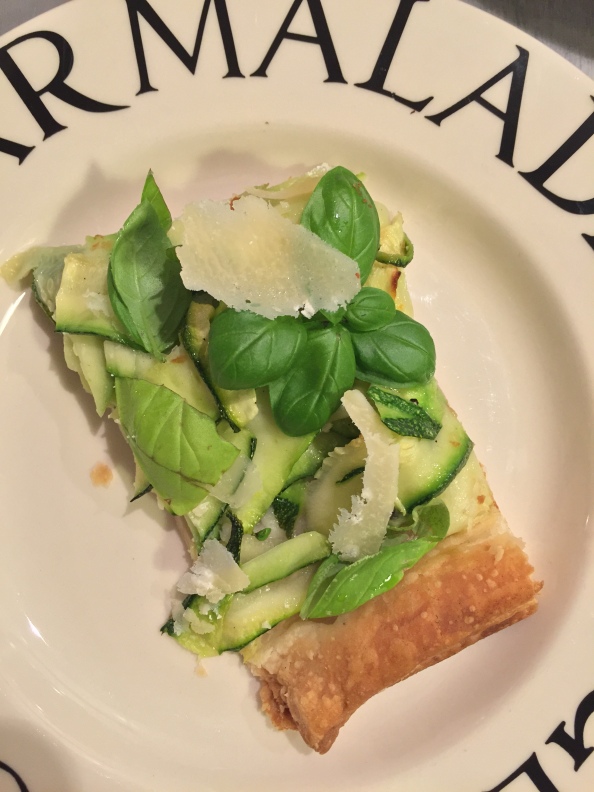
IMG_3628

Next, burgers.  This was a very last minute supper.  It was a lovely warm evening and so we shelved our original supper plans and youngest son popped to Waitrose to buy some ground beef (not too lean) and burger buns.  All I do to make burgers is add ground black pepper and an egg, mix well and shape.  I don’t add onion or salt or garlic.  This way you can really taste the beef and get additional flavours from the sauces and other toppings you serve alongside (eg gherkins, ketchup, bbq sauce, mustard, cheese, lettuce, sliced tomatoes).  Sometimes we sandwich our burgers in ciabatta but, to be honest, the regular burger buns with sesame seeds work perfectly.  On this occasion, in addition to the toppings listed above, I found some red Romano peppers in the fridge which I halved, deseeded, drizzled with olive oil and sprinkled with salt for my husband to grill on the barbecue.  J invited his friend round to join us and by the time we were ready to eat it was nearly dark so we lit some candles and tucked in.  Impromptu evenings like this are very often the most enjoyable.

Once again, my latest favourite cookbook, Honey and Co., came up trumps when I wanted a simple fish recipe the other Friday.  The recipe in the book used sea bream but I could only get sea bass fillets; I doubt there’s much difference.  I just roasted the fish fillets (one each) in the Aga roasting oven for 8-9 minutes with a little olive oil and seasoning and squirted on some lemon juice at the end.  The salad ingredients are as follows (for 4 people):

  • 4 small Lebanese cucumbers or 1 long one
  • 250g red grapes
  • 4 sprigs fresh mint, leaves picked and chopped
  • 1 small bunch dill, fronds picked and chopped
  • Juice of half a lemon
  • 1 tsp salt
  • Ground black pepper
  • 3 tbsp extra virgin olive oil
  • 200g pain yoghurt (I used Greek style)

Peel the cucumber to create a zebra-striped effect, slice in half lengthways and use a teaspoon to scoop out the seeds.  Chop into crescents and place in a large bowl.  Wash and halve the grapes and add with the chopped herbs.  Season with the lemon juice, salt, pepper and olive oil and mix well.  Spread two tablespoons of yoghurt on each plate and pile some salad on top, ready for the fish when it’s cooked.  Et voilà.

Salade Niçoise

Salade Niçoise is one of my favourite summer salads.  On summer holidays in France I would always order it.  But what is it exactly?

Last weekend I decided to make it when my son W and his fiancée were home, but realised I’d never used a recipe and always just made it up as I went along.  Browsing some of my cookery books, magazine cuttings and Google, I realised that there were many different versions of this salad.  I consulted Twitter too: there were as many people declaring potatoes were definitely not to be added as there were those who insisted on them.  What to do?  The wonderful Felicity Cloake had of course done the research in this article in her “How to make the perfect” series, but her “perfect” recipe was not my perfect one.  In reading about the salad, I was surprised at how many chefs, including Felicity, did not include tuna.  For me, this salad is one of the best vehicles for tinned tuna.  I was also surprised that green beans were not a regular addition.  I liked the raw broad bean idea but it would be more time consuming for this fairly lazy cook.  (I also didn’t skin or deseed my tomatoes: what of it?)

In conclusion, there doesn’t seem to be a an agreed upon, universal recipe for Salade Niçoise but what does it matter?  Make a salad with the the ingredients you like and which you have to hand.  On this particular occasion, mine was made with new potatoes which I added to the vinaigrette (some say mustard is a no no but I’m not one of them) while still warm, green beans, cooked and refreshed in cold water, tomatoes, tinned tuna, black olives, anchovies (essential) and hard boiled eggs.  I also added cucumber but this was a mistake: too watery.  It may not have been authentic, but with crusty ciabatta to mop up the dressing, it made for a delicious Saturday lunch.  And next time I make it, it might well be completely different.


Pomegranate Molasses Chicken with Bulgar Wheat Salad

Pomegranates have been featuring regularly in our meals at home recently and this week I read this about their possible anti-ageing properties, which was interesting and encouraging.  And the great Ottolenghi gives us these useful tips about them.  I love his books, Plenty and Plenty More, which my sons gave me for Christmas the year before last, but it is true that the recipes are often quite complicated with long lists of ingredients.  This is fine if you have time and the inclination but there are days when you have neither but still want to eat well.  This is where two other favourite Middle Eastern recipe books of mine come in: Persiana and my newest book, Honey & Co.  I have cooked quite a few things from the latter in the last few weeks and every single one has been a gem and just right for summer (such as it is) eating.

I commend one to you in particular which is so good I made it twice in a week.  It’s:

Pomegranate Molasses Chicken with Bulgar Wheat Salad

Ingredients

  • 8 skinless, boneless chicken thigh fillets

(serves 4)

Marinade

  • 2 cloves garlic crushed
  • 1 green chilli, sliced
  • 3 tbsp pomegranate molasses
  • 1 tbsp vegetable oil
  • Freshly ground black pepper

For the salad

  • 200g bulgar wheat
  • 1/2 tsp salt
  • 1 tsp olive oil
  • 200ml boiling water
  • 50g shelled pistachios, roasted and coarsely chopped (half reserved to sprinkle on top)
  • 75g currants
  • 1 tbsp pomegranate molasses
  • 50g fresh pomegranate seeds (1 tbsp reserved to sprinkle over the top)
  • 1 small bunch mint, roughly chopped
  • 1 small bunch flatleaf parsley, roughly chopped

Method

  • Mix the marinade ingredients together and use to coat the chicken all over.  Cover and keep in the fridge for a minimum of 2 hours to marinate.  You can do this overnight.
  • Preheat conventional oven to 200ºc/180ºc fan
  • Place the bulgar wheat in a large serving bowl/dish with the salt and oil, pour over the boiling water and cover with cling film for 5 minutes
  • Uncover and fluff up the bulgar using a fork
  • Add all the remaining ingredients except those you have reserved to use as garnish, and stir well
  • Place the chicken thighs on a large roasting tray lined with bake-o-glide and season with salt and pepper (non Aga users: fry on the hob for a few minutes each side and finish off in the oven)
  • Roast near the top of the roasting oven for about 30 minutes, turning them over halfway through
  • Serve the chicken on top of the salad and sprinkle with the reserved pistachios and pomegranate seeds


IMG_3107

Pasta Salad

IMG_3044

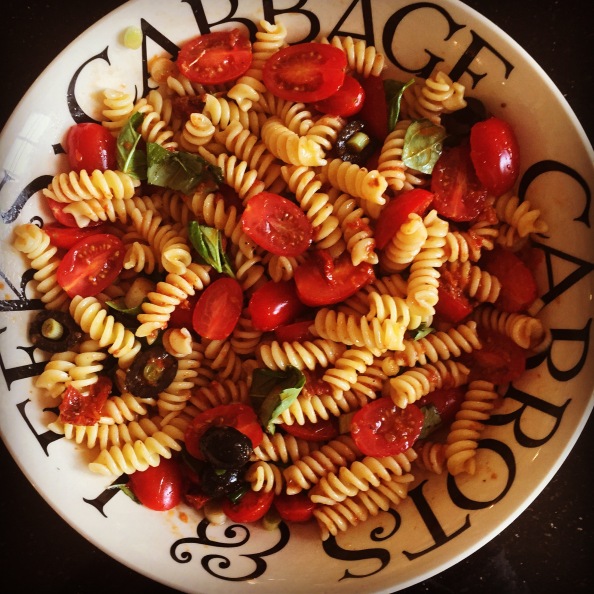
Salad can be many different things: a side dish or a main meal; vegetarian or containing meat; cold or warm.  This delicious pasta salad works both as a (vegetarian) meal in itself and as an accompaniment to barbecued meats.  Youngest son and I had it for supper the other night when my husband was at a meeting.  We nearly didn’t have any supper at all.  Just as we were sitting down to eat I dropped my glass of water on the granite work surface and it shattered into millions of pieces.  I was still finding tiny shards of glass the next day, including in my sandal, even though I had vacuumed and swept very thoroughly.  Fortunately though, I’d moved the bowl of salad to the table before dropping the glass so we were able to eat our supper without tearing our insides to shreds.

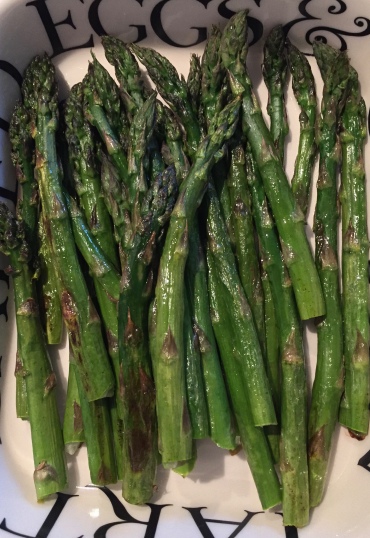
We ate this with some roasted asparagus spears.  At this time of year, my kitchen is hardly ever without British asparagus.  You have to make the most of the short season.

Pasta Salad with Tomatoes, Basil and Black Olives

Ingredients

  • 175g dried pasta
  • 1 tbsp extra virgin olive oil
  • 4 sun-dried tomatoes in oil, drained and sliced
  • 225g cherry tomatoes, halved
  • 4-6 spring onions, sliced
  • 8-12 black olives, pitted and halved
  • 8-12 fresh basil leaves, torn

Dressing

  • 2 sun-dried tomatoes in oil, drained
  • 2 tbsp oil (from the sun-dried tomato jar)
  • 2 tbsp red wine vinegar
  • 1 garlic clove, peeled
  • 1 tbsp sun-dried tomato paste
  • pinch of sugar
  • sea salt and black pepper
  • 2 tbsp extra virgin olive oil
  • Basil leaves to garnish

Method

  • Cook pasta until al dente, drain and refresh with cold water.  Turn into a large bowl and toss with the oil
  • Add sun-dried tomatoes, cherry tomatoes, spring onions, olives and basil.  Toss
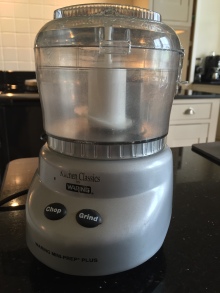
  • Make dressing: put sun-dried tomatoes, oils, vinegar, garlic and tomato paste in a blender (I used my mini food processor) with the sugar, salt and pepper and blitz until fairly smooth

    IMG_3136

    Mini food processor

  • Pour dressing over the pasta and toss well.  Ideally leave it for 1-2 hours for the flavours to infuse
  • Garnish with basil


To roast asparagus:

IMG_3143


Snap off the bottoms and lay the spears in rows on a roasting tray.  Drizzle over some extra virgin olive oil and sprinkle on some sea salt.  Put the tray in a hot oven (near the top of the Aga roasting oven) for 10 minutes, giving it a bit of a wiggle after 5 to move the spears around a little.  You can eat them hot like this, or let them cool then add a little lemon juice and black pepper, and maybe some shavings of parmesan to make another delicious salad.


Film Club Supper alla Bolognese

I belong to a little film club comprising eight friends.  We meet every six weeks or so and take it in turns to host.  The hostess (yes, we are all female) chooses the film and makes supper which we eat at the start of the evening, usually, but not always, sitting at a kitchen or dining room table.  Pudding and/or chocolates tend to be consumed on the sofa while watching the film.  We are allowed to pause the film for loo breaks, to make tea and coffee or to comment on or ask each other questions about the film.  It’s great fun.

We’ve watched a wide range of films over the years, both foreign language and English.  It was my turn to host our last meeting and I chose the film Carol with Cate Blanchett and Roony Mara.  I always mean to go to the cinema to see the Oscar nominated films but invariably don’t get around to it, so film club presents an excellent opportunity.  And it’s so easy to watch films these days.  On this occasion all I did was log on to Amazon Instant Video to rent the film and within seconds it was available to watch.

We liked the film very much.  It is beautiful and moving and Cate Blanchett’s performance is every bit as good as one has come to expect.  But I will leave film reviews to others and move on to important matters like the food!

Supper was Rick Stein’s Bolognese sausage ragù with tagliatelle.  I’d recently watched his programme from Bologna in which he’d toured that city’s food markets and restaurants.  It had transported me back to a wonderful holiday we’d enjoyed in that region of Italy when we’d also discovered its delicious cucina.

During the programme Stein made the ragù and I decided there and then to make it for film club.  My guests were too polite to say so but I know it was a little dry.  I was trying not to add too much wine/stock/cream to adjust for the fact that, as I’ve mentioned before in this blog, Agas are brilliant at retaining moisture.  But I went too far and felt we could have done with a little more creaminess to coat the strands of tagliatelle.  The flavour, however, was superb: with the aroma of fennel, rosemary and chilli, we could almost have been in Bologna.  I will definitely be making it again soon and might update this post if I get the liquid:sausagemeat ratio right next time, but for  now, here’s the recipe with my suggestions based on my experience.

By the way, I made double the BBC recipe linked to above (there were seven of us eating that night) and cooked, I felt, a little too much tagliatelle (750g).  I didn’t add all of it to the ragù but there was still plenty; nor did I emulate Rick Stein and make my own pasta.  I chose this very good quality one by  “Artigiano Pastaio” which is not cheap but worth it for a treat.

Finally, at the last minute, with my friends arriving on the doorstep, I remembered just in time to take a few photos.   Taking photos of the food needs to become second nature to me and I must learn to ignore my family when they roll their eyes at me for holding up the meal in order to take pics, or I won’t be able to call myself a blogger.

Ingredients

(For 4 people)

  • 400g fresh or good quality dried tagliatelle (or homemade as per Rick Stein’s recipe)
  • 400g sausagement
  • 1 tbsp olive oil
  • 1 medium onion, chopped
  • 2 sticks celery, chopped
  • 3/4 tsp fennel seeds, roughly ground in pestle and mortar
  • 1/4 tsp chilli flakes
  • 1 sprig rosemary, leaves finely chopped
  • I large clove garlic, crushed
  • 150ml dry white wine
  • 150ml chicken stock
  • 150ml double cream
  • Salt and pepper
  • Grated parmesan to serve

Method

  • Heat the oil in a large casserole on the boiling plate and break up the sausagemeat into it.  Cook for about 10 minutes, stirring all the time, moving it to the simmering plate if it seems too hot
  • Add the onion, celery, fennel seeds, chilli flakes and rosemary and cook for about 15 minutes until the onion is soft.  You can do this in the simmering oven, maybe for a little longer than 15 minutes
  • Add the garlic, give it a stir and then pour in the white wine.  Cook for 10 minutes or so on the simmering plate until it’s reduced.  Then add 100ml of stock and 100ml of cream, season, let it come to a simmer then cover with a lid.  Cook in the simmering oven for 30 minutes or so and take a look.  If you think it looks a bit dry add the rest of the stock and cream.
  • You can leave it for an hour or two in the simmering oven.  When you’re nearly ready to eat, cook the tagliatelle according to packet instructions and when it’s al dente, drain, add it to the ragù and mix it in.

Serve with a dressed green salad.

I haven’t posted for a while so here are photos of other things we’ve been eating lately.  First, I made Mamma Moore’s apple cake again, but this time with rhubarb, of which my allotment-owning sister-in-law brought a whole load when she visited recently.  It worked superbly; rhubarb and ginger have a real affinity.

And then last night we had the simplest of seasonal dishes: trout caught the night before by my husband’s friend, baked in the oven with lemon juice, butter and parsley and accompanied by Jersey Royal new potatoes, carrots and fresh peas.

Cavolo Nero

4f3d21f62542b_cavolo_nero


Cavolo nero is a cousin of kale and both belong to the brassica family.  Its long leaves are so dark green in colour, they’re nearly black or “nero”.  It originates from Tuscany where it was first believed to be grown in 600BC.

I can’t say when it first started to appear in our greengroceries and supermarkets but it doesn’t seem like long ago.  Since I first discovered it, relatively recently, I’ve used it mainly in minestrone and in pasta dishes.  It has a deliciously rich and intense flavour.

Not surprisingly, cavolo nero works well in pasta dishes and this recipe by Stevie Parle, which appeared in the Telegraph a couple of years ago, is delicious.

Ingredients

  • 500g penne
  • 300g cavolo nero (you can strip the leaves from the stem if you like but since it’s going to be puréed I don’t think it’s necessary. I just chopped mine up.)
  • 2 garlic cloves, peeled
  • 3 tbsp pine nuts, lightly toasted
  • 150ml extra virgin olive oil
  • Grated parmesan to taste

Method

  • Bring some salted water to the boil with the garlic cloves in a large saucepan and add the cavolo nero.  Cook for 5-10 minutes until tender and drain, keeping the garlic cloves
  • Transfer this and the pine nuts to a food processor and blitz.  Add the olive oil and parmesan (maybe a couple of handfuls), process again and season.  You will have a dark green sauce
  • Meanwhile bring another pan of water to the boil and cook the penne according to packet instructions
  • Drain the pasta, reserving a ladleful of the cooking water, return it to the pan and toss with the sauce, loosening it with some of the cooking water
  • Finish with a drizzle of olive oil and serve with more grated parmesan