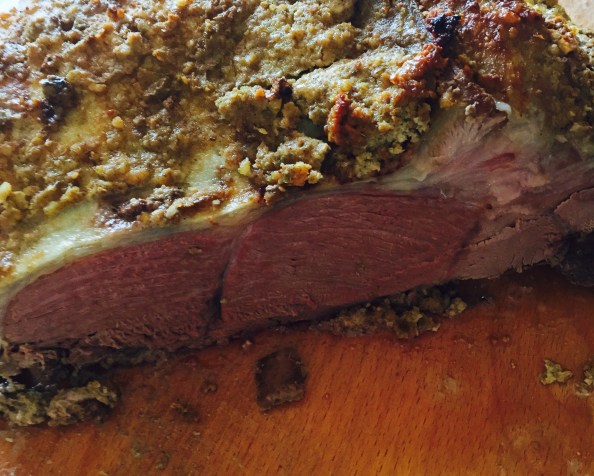
Indian Leg of Lamb

Indian Leg of Lamb

We had a lovely weekend at home this Easter, with our sons and two of their girlfriends joining us for most of it. I tried to keep the cooking as simple (but delicious) as possible and had a cooking-free Saturday night when we went to our local Italian to celebrate my birthday the previous week.

For Easter Sunday lunch I ordered a large leg of lamb from the butcher and asked him to remove the bone and butterfly it. My thinking was that it would cook more quickly and carve more easily (although carving is my (surgeon) husband’s job!).

On Saturday afternoon I prepared the marinade, covered the lamb and put it in the fridge to be forgotten about until Sunday morning.61zmh4n5vpl

I adapted the following recipe from Diana Henry’s book, Cook Simple.

Indian Leg of Lamb

For about 8 people

Ingredients

  • 1 x 2kg leg of lamb, boned and butterflied
  • 55g blanched almonds
  • 2 onions, roughly chopped
  • 8 garlic cloves, peeled and halved
  • a big chunk of fresh root ginger, peeled and roughly chopped
  • 4 green chillies, halved and deseeded
  • 550g plain yoghurt
  • 1 tbsp ground cumin
  • 4 tsps ground coriander
  • 2 tsps ground cinnamon
  • 2 tsps garam masala
  • salt and pepper

Method

  • Make deep gashes all over the meat with a sharp knife and put it in a dish
  • Blitz everything else in a food processor and spread this all over the lamb, massaging it in with your hands. It will look like this: IMG_4477
  • Cover with clingfilm and place in the fridge
  • On Sunday morning, preheat a conventional oven to 200ºC, take the lamb out of the fridge and let it come up to room temperature. Place it in a large roasting tin and cover with foil
  • Aga users: put it in the roasting oven for about 30 minutes, then remove the foil for 5 or ten minutes before placing the lamb in the simmering oven until you’re ready to serve lunch. This was 2pm in our case, so the total cooking time was about four and a half hours. If you’re using a conventional oven, the cooking time is about one and a half hours, with the foil removed for the last 20 minutes or so
  • Leave the lamb to rest on a board while you reheat the cooking juices, stirring as you go, to make a delicious sauce to be served with the lamb
  • I served our lamb with a pilaff, carrots roasted with coriander and garlic and two green vegetables

fullsizeoutput_1ebb

Slow-Cooked Chicken

img_4353

A friend came to supper the other day who said he had exactly the same Aga as mine. He confessed he didn’t think he and his wife made the best use of theirs and proceeded to ask me some questions. I was surprised to find they didn’t even know what the ovens were for: they only used the roasting and baking ovens (although they didn’t know this is what they’re called) and the simmering oven for warming plates. They didn’t use the warming oven at all! I told him they needed to buy an Aga book and that I’d read my Mary Berry one, which came free with my Aga, from cover to cover. He said they had the book but hadn’t bothered to read it.  In their defence, they “inherited” their Aga when moving into their house whereas I made a deliberate choice to become an Aga owner and cook and saw it as a kind of project. It made me realise there are people out there who didn’t choose to have an Aga but have got one by default and that they might find blogs like mine useful.

I was sorry therefore that the supper I cooked for our friend and his parents, old friends of my husband’s family, was not one of my best. I wanted to use up the pheasant breasts I still had in my freezer and found this recipe. It looked and smelled delicious and tasted good, but the meat was a little rubbery and dry. I find this happens with chicken breasts too and I don’t know what the answer is. What is more, I chose the recipe because it was a slow braise, which in my opinion ought to have ensured tender, succulent meat. On reflection, I think breasts, whether of the pheasant or chicken variety, should not be cooked for very long, so my suggestion for adapting this recipe for the Aga would be only to cook it (in the simmering oven of course) for the initial 45 minutes.

Legs and thighs, on the other hand, lend themselves to slower cooking. The dish in the photo above is braised chicken pappardelle. I got the recipe from Yotam Ottolenghi’s Guardian column, and you will see he provides two further slow-cooked chicken recipes. I pounced on the article when I saw it, as I always do when I see the words “slow-cooked”; I immediately think “Aga simmering oven”. I have now made all three recipes and they’re all superb, but today I’m going to tell you how I made the one above in the Aga.

Braised Chicken Pappardelle

Ingredients

  • 4 chicken legs (thighs and drumsticks)
  • 2 tbsp olive oil, plus extra to finish
  • Salt and black pepper
  • 3 carrots, cut into 1.5cm chunks
  • 1 large onion, peeled and finely chopped
  • 3 garlic cloves, peeled and crushed
  • 2 bay leaves
  • 5g thyme sprigs
  • 500g vegetable stock
  • 50g anchovies in oil, drained and finely chopped
  • 400g pappardelle (I used a good quality dried one)
  • 40g rocket leaves

Method

  • Put the chicken in a bowl and toss with the oil, a quarter teaspoon of salt and a generous grind of black pepper
  • Put a large, heavy-based casserole for which you have a lid on the simmering plate.  Sear the legs for ten minutes, turning them once, until the skin is dark golden brown, then remove from the pan.
  • Add the carrots, onion, bay leaves and thyme to the pan and cook until softened. You could do this in the simmering oven of course. Stir in the garlic and cook for a further minute
  • Return the chicken to the pan and add the stock, anchovies and a good grind of black pepper. Cover and cook in the simmering oven for at least an hour but two would be better
  • Lift out the chicken from the pot and bring everything to the boil on either the simmering or boiling plate and cook until the liquid is reduced to about 300ml
  • Meanwhile pull all the meat off the chicken bones in chunks or, as I prefer, shreds, and discard the bones and the thyme
  • Cook the pasta according to the packet instructions until al dente and drain
  • Add the chicken and pasta to the reduced sauce and vegetables and mix well
  • Divide between four plates or pasta bowls, layering with rocket leaves as you go
  • Drizzle with olive oil and serve

Apple Streusel Pie

img_4280

At a shoot lunch towards the end of the season, my husband was served what he termed “the best pudding I’ve ever eaten”.  He loved it so much he asked his hostess, Clare Pelly, for the recipe so that he could make it at home.  Only joking; I mean so that I could make it for us all.  I don’t mind at all: I’m happy to be the cook in our relationship because I enjoy it and because I’m better at it than he is, just as there are many things I don’t like doing which he is happy to do and is better at than me.  I imagine this is how most successful partnerships work.

As it turns out, I’m very grateful to him for getting me the recipe for this “best ever” pudding because it’s absolutely delicious.  Clare is also an Aga cook and the pie is particularly suited to Aga cooking because it can be baked on the floor of the roasting oven, which gives wonderful, crisp pastry.

Ingredients

For 1 x 10″/26cm or 2 x 7″/18cm flan tins

Pastry:

  • 8oz/200g plain flour
  • 4oz/100g butter
  • 1 tbsp icing sugar
  • 1 egg yolk
  • 2 tbsp cold water

Filling:

  • 2lbs/900g cooking apples
  • 2oz/50g raisins
  • 4oz/100g plain flour
  • 4oz/100g caster sugar
  • 2oz/50g butter
  • 10floz/285ml double cream

Topping:

  • 2oz/50g caster sugar
  • 2tsp cinnamon

Method:

  • Pre-heat conventional oven to gas mark 6/200ºC
  • To make the pastry, sift flour, rub in butter, stir in icing sugar and bind together with yolk and water.  Wrap in clingfilm and place in the fridge for about 30 minutes
  • Roll out thinly and line your prepared tin(s) with it.  No need to bake it blind
  • Peel, core and slice  your apples and mix with the raisins
  • Make a crumble by sifting the flour, stirring in the sugar and rubbing in the butter
  • Spoon half of this into the tin
  • Cover with the apple/raisin mixture and pour over the cream
  • Spoon over the remaining crumble mixture and sprinkle on the topping
  • Bake on the floor of the roasting oven for about 30 minutes until it’s bubbling and caramelised or brûléed on top.  Your pastry should be lovely and crisp, although you won’t know this until you’ve cut into it
  • Conventional oven: after 25 minutes turn it down to gas mark 5/190ºC for 10 minutes
  • Can be served hot, warm or cold

Aga note:

I always worry about the Aga cooling down if you give it too much to do at once but yesterday I cooked a pheasant, some roast potatoes and this pie in the roasting oven in the space of one and a half hours and everything was perfectly cooked.

Cinnamon:

The first time I made this pie we were a little disappointed that the cinnamon flavour wasn’t very strong.  Cinnamon is one of my husband’s favourite things so he did a bit of research.  First of all he saw that the cinnamon I’d used (by Bart’s) was a blend “sourced from several Fairtrade producers” and that the cinnamon considered to be the best is from Ceylon.  So from the website cinnamonhill.com I bought some Ceylon cinnamon sticks and the next time I made the pie, we used the fine Microplane grater to grate some for the topping and reader, I can confirm it tasted noticeably better.

This slideshow requires JavaScript.

Overnight Aga Porridge

Porridge has always been around of course but it has become fashionable in recent years.  This doesn’t mean we should reject it as a fad; quite the reverse.  In fact part of the reason it has become so popular is that its nutritional and health-giving properties have been well publicised.  There are studies which show it can help reduce blood cholesterol levels, for example.  Oats are low fat and have a low GI (glycaemic index) which means a slow release of the carbohydrate into your bloodstream so your energy levels are sustained for longer and you are less likely to feel hungry mid-morning.

Porridge doesn’t have to mean oats; it can also be made with rye, spelt or barley.  I think the two brands of porridge oats most commonly found in our supermarkets are Quaker and Scott’s, but other names are coming to the fore and building a reputation for wholesome breakfast cereals.  And we are discovering more about the different types of porridge; we are probably mostly used to oats which have been steamed and rolled into flakes (rolled oats like Quaker and Scott’s) but there are also the oats cut into two or three pieces (called, steel-cut, pinhead or coarse oatmeal).  It is said that because of their size and shape, the body breaks these down more slowly, thus keeping you full for longer.

A bowl of porridge can be made fairly speedily using rolled oats, in a saucepan or the microwave, but pinhead oatmeal requires some forward planning.  The instructions on the one we buy, by Rude Health (see photo), advise overnight soaking and this is where the Aga comes in, because a mere three or four minutes’ preparation at bedtime means one can wake up to a saucepan of porridge which requires just a quick stir and the addition of your favourite toppings.

So this is what you do:

  • Just before you go to bed, place 75g oatmeal per person in a pan and add 600ml water.  In truth, this makes a large portion so if making for two people, I only add half the amount again, ie I use 112g and 900ml water; for three people 150g/1.2l and so on.  You can add a pinch of salt too if you like.  My youngest son doesn’t like salt in his so I add a little to my own portion in the morning.
  • Place your saucepan on the boiling plate and start whisking with a balloon whisk.  Keep doing this for about a minute, making sure you get into every “corner” of the pan, and then transfer to the simmering plate and do the same for about two more minutes until the mixture is simmering.
  • Cover and place in the simmering oven and go to bed.
  • Next morning, put the kettle on (for tea), take the pan out of the oven and give the mixture a good stir with a wooden spoon.  Serve.

You can now add whatever takes your fancy.  Here are some options:

  • A little cold milk and sprinkling of demerara sugar
  • Dark muscovado sugar stirred into the porridge before adding milk or cream
  • Maple syrup, raisins and a little double cream (husband’s favourite)
  • Peanut butter
  • Honey
  • Cinnamon and a little sugar
  • Berries (blueberries, raspberries): keep some in the freezer and defrost overnight.


Aga Cookshop Sale

I try to avoid the January sales unless I want to check whether something I’ve had my eye on for a while is reduced.  I usually do this online because shops during the sales are not particularly pleasant environments.

It is not worth buying something just because it’s cheap; you have to know you are going to get a lot of use out of it.  This is why I am often tempted by items on the Aga Cookshop website, particularly textiles like oven gauntlets and tea towels.  They don’t last forever, so if yours are looking worn and threadbare, I suggest you head over there.  This is the link.

img_4206

By the way, I didn’t get them from the Aga shop but I am thrilled with these large hooks for hanging tea towels and oven gloves.  (Smaller hooks seem to be available everywhere but don’t quite fit on the Aga rail.)  I found them in my wonderful local shop, Kitchens Cookshop.  I can’t believe it took me ten years of owning an Aga to discover this way of ensuring these much-used items are always close to hand.


NB: I am not sponsored by Aga or the Aga Cookshop; I just enjoy sharing tips with fellow Aga owners and cooks.


Aubergine and Pea Curry

singin-in-the-rain-7438_1

So that’s it for another year and we can get back to normal, whatever “normal” is. The tree has been taken down and is currently awaiting collection in our front garden; all the decorations have been stored away in the spare room cupboard; and Sons 1 and 2 have returned to work, in Cambridge and London respectively. It was so lovely to have them at home, sometimes with and sometimes without the girlfriend of one and  the fiancée of the other, and although I should be used to it, I always feel a little sad when they’ve gone; not too sad, mind, because, as my mother says, if your children are happy to leave home, then you have probably done a good job as a parent. Son 3 stayed on for an extra couple of days which softened the blow, as much for his younger brother as for their parents. We all love films but Son 3 is the proper film buff of the family and at his suggestion we sat down on Monday evening to watch Singin’ in the Rain. I hadn’t seen it for years and had forgotten just how marvellous it is and what a wonderful actress the late Debbie Reynolds was: RIP. He returned to London with his dad yesterday, leaving youngest son and me, and Granny in her flat downstairs, in a very quiet house until the weekend.

Before he left I borrowed one of his Christmas presents to make supper: the book Fresh India by Meera Sodha, which is on the bestseller lists. Having eaten so much meat over Christmas we were all craving meat-free dishes and the aubergine and pea curry fitted the bill. The last thing I need is another cookbook but if this recipe is anything to go by, I might be adding this book to my birthday wish list.

Aubergine and Pea Curry

  • 5 tbps rapeseed oil
  • 1 teaspoon cumin seeds
  • 2 large onions finely chopped
  • 6 cloves of garlic, crushed
  • 4 large ripe tomatoes, chopped
  • 1 1/2 tbsps tomato purée
  • 1 1/2 level tsps salt
  • 1 1/4 tsps chilli powder (unless like mine, yours is very hot, in which case use less)
  • 1/2 teaspoon ground turmeric
  • 1 teaspoon sugar
  • 4 medium aubergines 1.2kg, chopped into 3cm cubes
  • 100g (I used 200g) peas (fresh or defrosted)
  • Put the oil in a wide-bottomed lidded pan on the simmering plate (conventional hob: medium heat). Once hot, add the cumin seeds and stir for 30 seconds. Add the onions and stir to coat in the oil. Cook (in the simmering oven) for 15-30 minutes until translucent but not brown.  Add the garlic and stir-fry for a couple of minutes
  • Add the tomatoes and purée and cover with a lid. Leave to cook for 5 minutes (or longer in the simmering oven), then add the salt, chilli powder, turmeric and sugar and cook for a further couple of minutes
  • Now add the aubergines, coating the pieces with the masala, pop the lid back on the pan and cook for around 10 minutes (or longer in the simmering oven). You want the aubergines to be tender and soft with little or no water running from them. If they’re watery or not yet tender, they may need another few minutes’ cooking
  • When they’re cooked, add the peas and cook for a couple of minutes
  • Serve with hot chapattis or plain boiled Basmati rice

NB:

  • I used one of those large round aubergines from Natoora. It weighed 620g and I was worried it would not be enough but it was plenty. Am therefore a little baffled by the aubergine quantity recommended in the book. Would it not have led to a very dry curry?
  • Also: I only used 5 cloves of garlic and 1 large onion.


Apologies that I don’t have a photo of this dish (but then nor does the book!). Instead here are a few photos of our Christmas.


Chilli con Carne


img_4095

Saturday can be a day for relaxing and pottering.  One is refreshed after a lie-in perhaps, and the chores that need to be completed before the start of the working week can be delayed until tomorrow.  A day such as this is perfect for some slow cooking and for spending time near the Aga.

Last weekend got off to a particularly enjoyable start when we went out on Friday evening for a meal with some friends.  They introduced us to Bulrush, a fairly new Bristol restaurant, which seems to be gaining in popularity by the day.  We discovered that it had not been over-hyped, either by our friends or in the media, and enjoyed every one of the nine (!) courses on the taster menu.

It was not a late night so I felt rested on Saturday morning.  My husband went off to do a ward round, youngest son to do his paper round and I walked the dog.  Once we’d had breakfast and dressed I popped down to the farmers’ market for some sourdough bread for lunch and came home to start on the chilli I’d planned for supper.  At this time of year I love Saturday evenings when we have no plans because it means I can sit and watch Strictly Come Dancing with a gin and tonic and organise for the supper to be ready afterwards.  Chilli works well because it can be left to bubble away all afternoon in the simmering oven and all that’s required as Strictly is coming to an end is to cook some rice and make a salsa.

I suspect for many of us chilli is one of those dishes which we make from memory, perhaps using slightly different ingredients each time.  For years I’ve been basing mine on this ragù recipe; I just substitute red wine for white, add chilli powder before adding the tomato purée and finally red kidney beans about half an hour before serving.  This weekend that is more or less what I did but instead of just chilli powder, I also added some cumin and some chipotle paste.  This provided added depth and smokiness and I was delighted with the result.

Ingredients

  • 2 onions, chopped
  • 3 garlic cloves, peeled and crushed
  • 2 tbsps olive oil
  • 1kg minced beef (full fat for flavour)
  • 1 heaped tsp ground cumin
  • 4 tsps chipotle paste
  • 1/2 tsp chilli powder
  • salt and pepper
  • 1 tbsp tomato purée
  • 2 bay leaves
  • 200ml milk
  • 200ml red wine
  • 500ml passata
  • 1 or 2 x 400g tins red kidney beans
  • Sour cream to serve

Method

  • Heat the olive oil in a large casserole and add the onion and a sprinkling of salt.  Stir to coat in the oil and leave to cook in the simmering oven, or if you’re in a hurry on the simmering plate, stirring regularly
  • When the onions are soft and translucent, add the crushed garlic, place the casserole on the boiling plate and add the mince and some salt, stirring and breaking it up with a fork as you go.  When it has lost its pink colour, transfer to the simmering plate and stir in the spices, chipotle paste and tomato purée
  • Then add the milk and bay leaves and let this cook, uncovered, until most of it is absorbed before you add the wine
  • After about five minutes add the passata, give it a stir and when it’s just about simmering, transfer, still uncovered, to the simmering oven for a minimum of three hours but it won’t come to any harm if left there for six.  Add the kidney beans about half an hour before you plan to eat
  • Serve with basmati rice, a dollop of sour cream and salsa

Salsa

I happened to use this Delia salsa recipe this time but there are many others and you might already have a favourite.  Simply mix all the ingredients together.

  • 1 large avocado, peeled and diced
  • 1/2 red onion, finely chopped
  • 2 tomatoes, deseeded and the flesh diced (you can also peel them if you like)
  • About a tablespoon of chopped fresh coriander or to taste
  • Juice of 1 lime
  • A few drops of tabasco
  • Seasoning


Mince Pies

This post is not about telling you how to make mince pies.  To be perfectly honest, as I may have mentioned before, I don’t rate my pastry-making skills and would not presume to pass on any tips, because you are probably all much better at it than me.

That is not to say that I don’t enjoy having a go.  What is more, there’s nothing like making mince pies for getting into the festive spirit and family and friends do appreciate homemade ones.  One of the reasons I’ve made a few in the last week is that I found a big jar of Waitrose mincemeat in my cupboard with a “best before” date of December 2016.  You see?  I don’t even make my own mincemeat!

For the pastry I use this excellent Xanthe Clay recipe.  Sometimes I make “closed” pies (see above) and sometimes I cut out pastry stars to place on top (see below).  I always brush with egg and sprinkle with caster sugar.  I fancy making some with an almond crumble topping one day.  I bought some like that at Bristol’s wonderful Hart’s Bakery yesterday and would love to try to emulate them.  But that’s for another day.

In the Aga

Mince pies bake very quickly in the Aga roasting oven.  Place your tray of pies on the grid shelf on the fourth rung of the oven.  They will be done in 15 minutes at the most.  The oven is hotter at the back and on the side nearest the centre, so I turn the tray round halfway through the cooking time.


Christmas Pudding

Christmas Pudding

As I confessed in my recent Christmas Cake post here I don’t always do a homemade Christmas pudding. After writing that, it struck me that this was really very lazy of me. “Call yourself a cook?” I asked myself, and resolved there and then to make one this year and every year. Honestly, it’s so incredibly easy and quick to make and doesn’t involve sophisticated baking skills.

The first thing you need to do is find a recipe. The one I recommend is this one by Bertinet’s in Bath. I’ve also bought Bertinet’s puddings in the past so when I found this recipe I was confident it would be delicious. I’ve also made Delia’s pudding (pretty sure you’ll find it online if you haven’t got her wonderful, and in my case much used, Christmas book) and one by the great Nigel Slater. My preference will always be not to mess about with the recipe and to stick to traditional ingredients, but if you fancy trying something a bit different, there are plenty of suggestions out there. For me, part of the beauty of preparing the Christmas meal is that it is the same (more or less) every year. With all that’s going on at that time of year, and the many tasks that need to be done, it takes the pressure off if you are not having to think up a new, imaginative menu on top of everything else.

So back to my pudding. You will see from the photos that I could not fit all my mixture in the recommended 2 pint basin and ended up with an additional small pudding; I intend to give this as a gift to the hostess of a party we’ve been invited to.

Christmas Pudding

Ingredients

You will need a 2 pint pudding basin (and maybe an additional small basin – see above)

  • 100g currants
  • 200g seedless raisins
  • 200g sultanas
  • 60g glacé cherries
  • 60g chopped candied peel
  • 90g blanched almonds, sliced into slivers
  • ½ cooking apple, peeled, cored and coarsely chopped
  • ½ carrot, peeled and grated
  • Zest and juice of half an orange
  • Zest and juice of half a lemon
  • 115g finely chopped suet
  • 115g plain flour
  • 60g white bread or brioche crumbs
  • 115 soft brown sugar
  • ½ tsp mixed spice
  • ½ tsp ground cinnamon
  • ¼ nutmeg, grated
  • ½ tsp salt
  • 3 eggs
  • ½ can Guinness
  • 2 tbsps brandy

Method

  • Put all the ingredients, apart from the orange and lemon juices, brandy, Guinness and eggs, into a large bowl and mix thoroughly
  • In a separate bowl beat the eggs until frothy and add the orange and lemon juices, Guinness and brandy
  • Add to the mixture in the other bowl and mix thoroughly until all incorporated
  • Fill your basin with the mixture and place a circle of greaseproof paper on top
  • Place in the fridge for at least 12 hours but up to 48 hours

Steaming: one way

  • Cover the pudding with clingfilm and then take a saucepan which holds the pudding basin and make sure you can fit the lid on
  • Place the pudding in it and pour in water about half way up the basin
  • Bring this to the boil on the boiling plate
  • Check the water level, put the lid on or cover with foil and place in the simmering oven to “steam” for at least 12 hours. Do it overnight and you will wake up to a heavenly Christmas-y aroma

Steaming: another (even easier) way

  • I recently discovered that even this initial steaming can be done in the Aga simmering oven without using any water at all. This is thanks to Sarah Whitaker, the all round Aga guru. All you do is cover the basin in foil or clingfilm and place it at the back of the simmering oven for 12 hours or overnight
  • Leave the pudding to cool in its clingfilm
  • You could then wrap it in muslin and tie it with string as you can see in the photo above. Foil or extra clingfilm would be fine; I just think it looks pretty (and traditional) in the muslin
  • On Christmas Day all you have to do is put the basin, wrapped in foil, in the simmering oven for four hours. How easy is that?

Norwegian Bløtkake

fullsizerender-2

This traditional Norwegian celebration cake (translation: soft cake) is part of my childhood in a way that no other food is. My grandmother, aunts, and mother all baked it regularly when I was growing up and then my mother passed the recipe on to me. Nowadays when we go on holiday to Norway, it’s my cousins who make the bløtkake and no doubt they have passed the recipe down to their children as I will to mine.

My mother is a great cook and loved introducing her British friends to Norwegian specialities, but when she was first married to my (English) father she also learnt to do an excellent Sunday roast and many other British recipes. She would make a bløtkake for our birthdays and if friends were coming round. For a few years she ran a small catering firm specialising in parties and weddings, and this cake was probably what her customers requested the most. I can remember helping her with deliveries sometimes which involved me sitting in the passenger seat of her car with the cake in a container on my lap, hoping we didn’t have to brake suddenly.

The cake is not complicated or difficult to make. It uses a fatless sponge so you needn’t feel guilty about the amount of cream required to make this cake delicious and special. I made it recently for my youngest son’s 18th birthday.

Ingredients

You will need an 8″ or 9″ springform cake tin, very lightly greased and base-lined.

  • 5 large eggs
  • 125g caster sugar
  • 125g self-raising flour
  • 300ml (or more) double or whipping cream
  • Fruit: strawberries, raspberries, blueberries or banana or combinations of these. I’m sure you will come up with other wonderful fruit ideas, depending on the season. The one above was a mixture of raspberries and blueberries. I also can’t give you quantities but I’m sure you’ll manage
  • Juice or milk for moistening the sponge

Method

  • Pre-heat a conventional oven to 150ºC
  • Whisk the eggs and sugar (ideally in a mixer or using an electric hand whisk) for 8-10 minutes (depending on the power of your whisk) until thick and very pale in colour. When you lift the whisk the mixture will leave a trail like a ribbon
  • Then fold in the flour; do this gently to keep in as much air as possible
  • Pour the mixture into your prepared tin and bake in the baking oven (see above for conventional oven temp) for about 25-30 minutes. Check it at 20 minutes and maybe turn it round so the other “side” is nearer to the back. If using a conventional oven, don’t even think about opening the door until it’s been in for 20 minutes. It is done if it springs back when pressed down gently with your finger
  • Cool on a rack for at least 10 minutes before turning it out of the tin. Leave it to cool upside down
  • When the cake is cold slice through the middle horizontally so you have two pieces. Even better, slice it into three layers.  In fact, I wish I’d done this for my son’s cake and will definitely do it next time. It makes a more impressive, moist and luscious cake. You may need more cream but given it’s a cake based on having lashings of cream, who’s going to quibble about that?
  • You need to moisten the sponge layers before filling the cake. You can use juice from the fruit (I had frozen raspberries which released a lot of juice after defrosting); or a little diluted elderflower cordial; or milk. We’re only talking about a couple of dessert spoonfuls
  • Whip the cream
  • Sandwich the cake together with the cream and fruit. Be generous with both
  • Finally, spread the rest of the whipped cream thickly over the whole cake and decorate with a little more fruit
  • It is customary to cut a circle in the middle of the cake and slice it from there. If it’s a birthday cake, the round piece can be saved for the birthday boy or girl

One more thing: if you don’t eat the whole cake at first sitting, and it is definitely best when fresh, make sure you store it in the fridge.

Update

My mother has read this post and passed on a tip which finishes the cake off nicely: keep back a little cream for piping round the bottom. As you can see from the photos, mine has a bit of a gap and would have been improved hugely if I had done this. What can I say, except I clearly haven’t inherited my mother’s knack for presentation.