Casseroles

IMG_2078


Spring was definitely in the air last weekend.  It was still chilly, especially in the early morning and evening, but when the sun was shining one could actually feel the heat from it.  Early Spring blossom has started to appear on the trees in Bristol and the daffodils are very much in flower.  So it might seem odd that I chose to cook rather wintry, comfort food dishes, but I thought I’d better get them in before temperatures really do rise.


Lancashire Hotpot

My husband says I can’t possibly write a post about this meal because we didn’t take a photo of it, but, with apologies for the lack of illustration, I’ve decided to do it anyway.  It was a success and the ideal thing to cook last Saturday when I had plenty of time in the morning but wanted to watch England play Wales in a crucial Six Nations rugby match in the afternoon.  Honestly, as you will see, this hotpot is more or less just an assembly job.  While I was preparing it I managed to keep an eye on the Italy v Ireland match.

For the ingredients, I more or less followed Felicity Cloake again and make no apologies for that.  Here is what I did.

Ingredients

(Serves 4)

  • 6 lamb cutlets
  • 400g diced lamb shoulder
  • Flour, salt and pepper
  • 3-4 large, floury potatoes
  • 2 sprigs thyme
  • 2 onions, sliced
  • 1 bay leaf
  • 300ml stock (Felicity says lamb stock, but I used a homemade chicken one because that’s what I had in the fridge, and it was fine.)
  • 20g melted butter, plus extra to grease.

Method

  • Dust the meat with the flour and seasoning.  Peel and slice the potatoes thinly.
  • Butter a casserole which has a lid.
  • Put a layer of overlapping potato slices in the bottom of the casserole, season them and sprinkle with a little thyme.
  • Put the meat and bay leaf on top, followed by the onions and some more seasoning.
  • Top with the remaining potatoes, overlapping them again.  Season these and pour on the stock, which should not come above the topping.
  • Brush the potatoes with the melted butter.
  • Put the lid on and place the casserole in the simmering oven.  Cook for 4-6 hours.
  • Thirty minutes before serving, remove the lid and transfer to the roasting oven to brown the potatoes.

I placed it in the oven at about 2pm and then all I had to do when we were ready to eat was steam some carrots (in the simmering oven of course) and cook some cabbage.


IMG_2565


By the way, for afternoon tea on the sofa, in front of the England v Wales match, we had buttered slices of this delicious “hot cross” fruit loaf which I’d bought in the morning from the Bordeaux Quay stall at Whiteladies Road Market.


Simple Stroganoff

This beef stroganoff, based on Delia Smith’s recipe, has the flavours of “proper” stroganoff but the advantage that it can be made ahead instead of at the last minute; it’s ideally suited to Aga cooking.

Ingredients

(Serves 4 people)

  • 700g fairly lean braising beef
  • 2 onions, sliced
  • 50g butter
  • 275 ml dry white wine
  • 250g mushrooms, sliced if large
  • 250ml sour cream
  • Freshly grated nutmeg
  • Salt and freshly milled black pepper

Method

  • Cut the meat into thin strips, about 5mm wide and no more than 6cm long.
  • Melt the butter in a casserole and soften the onion in it in the simmering oven for about 15 minutes.  Remove to a plate with a slotted spoon.
  • Place the casserole on the boiling plate and brown the beef in batches.
  • Once the meat is browned, move the casserole to the simmering plate and return the beef and onion to it.  Season and pour in the wine.
  • Bring to simmering point, put on the lid and let it cook in the simmering oven for 3-4 hours.
  • An hour before you want to eat, stir in the mushrooms, cover and return it to the oven.
  • Taste to check seasoning, stir in the sour cream with a good grating of nutmeg.  Don’t let the cream boil.
  • Serve with plain boiled rice and perhaps some broccoli or a green salad.

Depending on the weather, perhaps my next posts will move on to lighter, fresher dishes.

Paella

Paella might be my favourite dish.  For me it’s one of the most delicious things you can eat.

It’s made all year round but changes with the seasons.  I wonder if it’s one of those dishes like ragù in Italy where there are as many recipes for it as there are cooks.  Felicity Cloake quotes Valencian chef (Valencia being where paella originated) Llorenç Millo as saying that there are as many recipes as there are villages.

We  haven’t had a holiday in Spain for many years but we used to go to Nerja to stay in a friend’s appartment.  It was within easy walking distance of the beach along which there were several great restaurants.  Our favourite was the one where a man made paella over an open fire in the biggest paella dish you’ve ever seen.  The first time I saw this I watched him, enthralled, as he gradually added all the elements.  By the time he’d finished quite a crowd had gathered round to watch and then, finally, to eat.

He used to make what I consider to be be a traditional paella comprising chicken and seafood, but apparently paella didn’t start out as a fish or seafood dish at all.  Over the years I’ve made various permutations, the latest being this haddock one, based on a recipe by Tamasin Day-Lewis.  Hers used monkfish but there was none available when I was shopping and the haddock loin was a good alternative, in my view; I’m sure any firm white fish would work.  I’ve read that paella always contains some sort of pig meat (bacon, chorizo or pork) but I don’t think it’s essential.  My haddock one doesn’t and in fact I don’t remember the beach one containing any either.   Perhaps in future posts I’ll give you the recipe for my chicken and chorizo paella or Ottolenghi’s vegetable one, which is quite superb.  And I really ought to try Felicity Cloake’s “perfect” paella too.

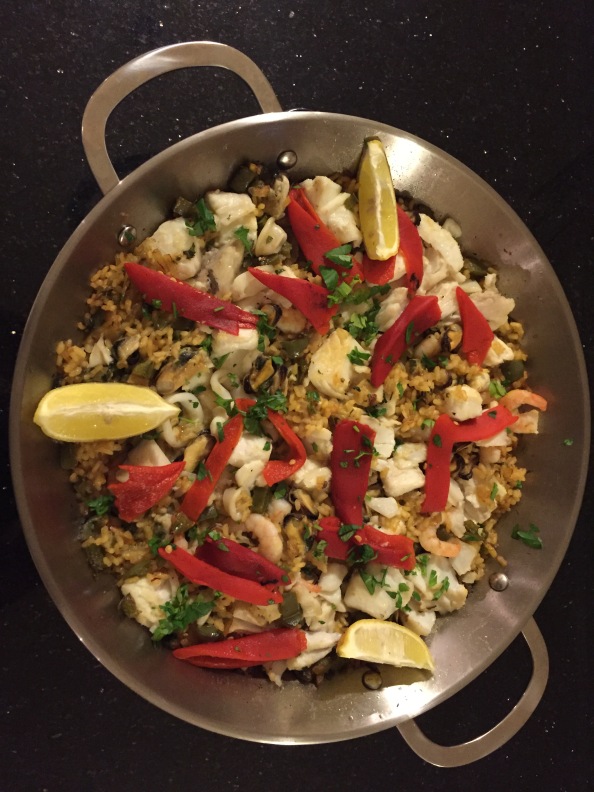
You don’t have to have a paella pan.  I’m thrilled with the one pictured, a recent purchase, but before I had it, I used either a large, deepish frying pan or a wide but shallow casserole.

Paella with haddock, saffron and peppers

Serves 4

  • 5 tbsp olive oil
  • 500g haddock loin, skinned and cut into 2-3cm cubes
  • 2 onions, finely chopped
  • 2 green peppers, halved, seeded and finely chopped
  • 4 cloves of garlic, crushed
  • 1/2 tsp fennel seeds
  • 500ml (approx) of good quality fish stock (I bought mine)
  • a good pinch of saffron
  • 225g bomba (sometimes called Calasparra) rice
  • A glass of white wine or fino sherry
  • 1 small bunch flat-leaf parsley, finely chopped
  • 1/2 tsp sweet smoked paprika
  • salt and pepper
  • About 200g mussels, prawns or squid or if you prefer, any combination of these. I used a packet of frozen, cooked mixed seafood, defrosted first.
  • 225g piquillo peppers, torn in strips

IMG_2563


  • Heat 2 tablespoons of the oil in your pan on the simmering plate.  Add the haddock and stir-fry for a couple of minutes until slightly underdone.
  • Tip the fish into a dish with its juices, wipe the pan clean with kitchen paper and return to the simmering plate.  Add the remaining oil and then the onion and green pepper.  Give them a stir, coating everything in the oil and move to the simmering oven to cook for about 20 minutes until soft, adding the garlic and fennel for the last 5 minutes or so.
  • Meanwhile bring the stock to the boil in a saucepan on the boiling plate and infuse the saffron in it off the heat.
  • Add the rice to the paella pan on the simmering plate and stir to ensure every grain is coated in the oil.
  • Add the wine or sherry, followed by most but not all of the saffron-infused stock, half the parsley and the paprika and season with salt and pepper.  Do not stir from this point.
  • Once this is simmering, place it either near the bottom of the baking oven or in the simmering oven, uncovered, until there is very little liquid left.  Difficult to give precise timings because I find it varies (and as you know, timings are not usually crucial in an Aga) but maybe 30 minutes in the baking oven and 15 in the simmering oven.  If it looks dry and the rice is still not tender, add the rest of the stock.
  • When there’s still a little liquid left above the rice add the fish and seafood, pushing it down into the stock and return to the simmering oven until heated through.  It wouldn’t do any harm to leave it for half an hour like this, if you’re not quite ready to eat, but try not to leave it too long if you’ve added prawns, because they go tough and rubbery when overcooked.  Place the strips of piquillo peppers on top.
  • Let the rice sit for a few minutes on the warming plate before serving.  Finally, decorate with lemon wedges and the remaining chopped parsley.


IMG_4532

Paella with haddock and saffron

Supper à Deux: Darina Allen’s Penne with Tomatoes, Chorizo and Cream

Supper à Deux: Darina Allen’s Penne with Tomatoes, Chorizo and Cream

Last Saturday evening our youngest son was heading out to a party.  I like to think we’re old hands at matters teenage so we trod carefully and got away with asking a few questions, which elicited the following: it was local, so he could walk to it, and was being hosted by two of his school friends. We were also told he and others would be gathering at a friend’s house beforehand and walking to the party together.

We’ve been here before of course, my husband and I. The difference is that when our older boys went to parties, there was always at least one left behind who, depending on his age at the time, needed some sort of attention from us. Since our third son left home to seek his fortune (well, first to go to university and now London to try out various jobs) our life has been undergoing subtle change. We’re very gradually becoming accustomed to just the two of us sitting down to eat together, but it’s still quite a rare thing because my husband tends to be away two nights a week in London. And we won’t be proper emptynesters until we can go to sleep without listening out for the key in the door announcing that someone has arrived home safely.

So that he could dash off to meet his friends on Saturday without going hungry, the boy ate a large, late lunch. Once he’d gone, I set about preparing this pasta dish which I’d found on the BBC website. It was the first time I’d cooked anything by Darina Allen, but it was delicious and I’ll definitely make it again and seek out more of her recipes. I halved the quantities and, I confess, DID NOT peel the tomatoes, but I did deseed them. I hate fiddly cooking jobs. I’m probably rather a lazy cook. I also left the rosemary out. Get me.  Oh, and we didn’t have parmesan with it either.

Darina Allen’s Penne with Tomatoes, Chorizo and Cream

Ingredients

  • 450g penne pasta
  • 25g butter
  • 1 tsp finely chopped rosemary
  • 700g fresh ripe tomatoes, peeled, seeded and diced
  • salt and freshly ground pepper
  • sugar, pinch of
  • 175-225g chorizo
  • pinch chilli flakes
  • 125-175ml cream
  • 3 tbsp finely chopped flatleaf parsley
  • 4 tbsp freshly grated parmesan, to serve (optional)

Method

  • Melt the butter in a saucepan on the simmering plate, add the chopped rosemary and diced tomatoes
  • Season with salt, pepper and sugar
  • Cook in the simmering oven until the tomatoes have just begun to soften into a sauce
  • Chop the chorizo into small chunks, say 5x5mm, and add to the pan with the chilli flakes
  • Add the cream and two tablespoons of the parsley, and allow to bubble for 3-4 minutes on the simmering plate, stirring frequently until the cream has reduced by half.  Keep this warm in the simmering oven
  • Cook the pasta (on the boiling plate) until al dente, drain and stir into the sauce
  • Sprinkle with the remaining parsley

We also ate some of the Bordeaux Quay focaccia I’d bought at Whiteladies Road Market in the morning, which probably made the meal somewhat carb heavy but hey, it was Saturday night and we thought we’d live a little. We drank a glass or two of Rioja too!