Green Beans And Vinaigrette


Look away now if you don’t approve of buying those packs of fine green beans imported from Kenya and Zambia because of the air miles involved in getting them here.  We like them in this house so I do buy them.  In the last few weeks Waitrose has been stocking homegrown ones which seem a little fatter but are full of flavour.

One of my favourite ways of serving them in the summer is as a salad in a classic vinaigrette.  I cook the beans, drain them, plunge them in cold water so they retain their colour and drain them again.  And then I toss them in the vinaigrette which I make as follows:

  • Put a teaspoon of Dijon mustard in your salad bowl
  • Add a little salt, freshly ground black pepper and 1/2 tsp of sugar
  • Add 1 tbsp of white wine vinegar
  • Using a small whisk mix this a little and then slowly pour on extra virgin olive oil, continuing to whisk all the time.  I cannot tell you how much oil I use.  It emulsifies gradually and somehow I just know when it’s enough.  I taste it too of course: if it’s still very tart I might add a little more oil

You may prefer to make your dressing in a jug or small bowl, or in a jam jar by placing all the ingredients in it, putting on the lid and giving it a shake.  I find it easier to make it in the salad bowl and have got used to knowing how much dressing I need for the amount of salad I’m making.  Sometimes I vary it; for example, I might omit the mustard and add red wine vinegar instead of white, a little crushed garlic and some chopped flat leaf parsley; or, to avoid a too strong taste of raw garlic, I’ll peel and flatten a clove slightly and leave this in the dressing but remove it when it’s time to serve the salad.  This provides a mere hint of garlic flavour.

Making the dressing in the salad bowl takes me back to one of my first stays in France as a teenager.  I was 15 and went to stay with the family of Sophie, whom we had hosted the previous year.  Sophie lived in the heart of Burgundy country in a stunningly beautiful house which seemed to me like half a chateau.  She must have found our house in England very small.  It was a very hot summer and all meals were taken outside with rarely fewer than about ten people at each sitting.  Sophie’s father ran his own business and always came home for lunch, sometimes bringing a couple of colleagues with him.  We girls occasionally helped their maid, Lily, in the kitchen and that is where I learnt to make vinaigrette.  Another memory is Sophie’s father taking his lunchtime red wine (Burgundy, obviously) with ice cubes.  My father was astonished when I told him this.  I returned from that holiday with much improved French, new friends and feeling very worldly wise.
Summer “Cooking”

Maybe I’m just making excuses to be lazy but the summer weather means I haven’t felt much like baking or cooking recently.  It hasn’t even been consistently hot and sunny but here in Bristol, even on the wet, grey days, it’s been muggy: not the sort of weather conducive to standing next to a hot oven for a few hours.

The solution is either to get your husband to barbecue or to prepare salads and light dishes requiring minimal cooking time.  I have managed to achieve both of these and thought I’d share with you some of the recipes we’ve enjoyed.

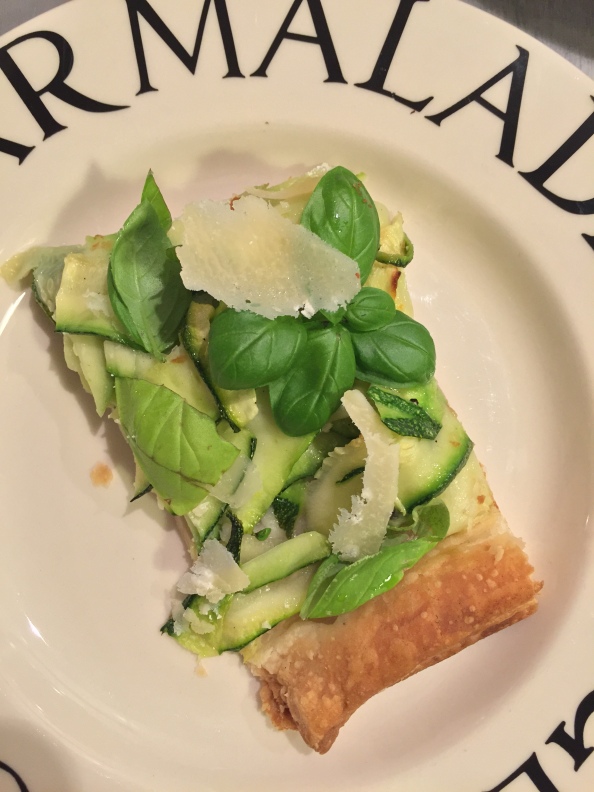
First up, this courgette tart, which was an excellent way of using up some superb homegrown courgettes a friend had given us.  The recipe is by Rose Prince and appeared in the Saturday Telegraph magazine a couple of weeks ago.  You will see that she recommends making your own rough puff pastry but I went for second best and used shop bought pure butter puff pastry.  I was not that successful at getting my courgettes to form “ribbons” but it didn’t matter that much.

IMG_3628

Next, burgers.  This was a very last minute supper.  It was a lovely warm evening and so we shelved our original supper plans and youngest son popped to Waitrose to buy some ground beef (not too lean) and burger buns.  All I do to make burgers is add ground black pepper and an egg, mix well and shape.  I don’t add onion or salt or garlic.  This way you can really taste the beef and get additional flavours from the sauces and other toppings you serve alongside (eg gherkins, ketchup, bbq sauce, mustard, cheese, lettuce, sliced tomatoes).  Sometimes we sandwich our burgers in ciabatta but, to be honest, the regular burger buns with sesame seeds work perfectly.  On this occasion, in addition to the toppings listed above, I found some red Romano peppers in the fridge which I halved, deseeded, drizzled with olive oil and sprinkled with salt for my husband to grill on the barbecue.  J invited his friend round to join us and by the time we were ready to eat it was nearly dark so we lit some candles and tucked in.  Impromptu evenings like this are very often the most enjoyable.

Once again, my latest favourite cookbook, Honey and Co., came up trumps when I wanted a simple fish recipe the other Friday.  The recipe in the book used sea bream but I could only get sea bass fillets; I doubt there’s much difference.  I just roasted the fish fillets (one each) in the Aga roasting oven for 8-9 minutes with a little olive oil and seasoning and squirted on some lemon juice at the end.  The salad ingredients are as follows (for 4 people):

  • 4 small Lebanese cucumbers or 1 long one
  • 250g red grapes
  • 4 sprigs fresh mint, leaves picked and chopped
  • 1 small bunch dill, fronds picked and chopped
  • Juice of half a lemon
  • 1 tsp salt
  • Ground black pepper
  • 3 tbsp extra virgin olive oil
  • 200g pain yoghurt (I used Greek style)

Peel the cucumber to create a zebra-striped effect, slice in half lengthways and use a teaspoon to scoop out the seeds.  Chop into crescents and place in a large bowl.  Wash and halve the grapes and add with the chopped herbs.  Season with the lemon juice, salt, pepper and olive oil and mix well.  Spread two tablespoons of yoghurt on each plate and pile some salad on top, ready for the fish when it’s cooked.  Et voilà.

Salade Niçoise

Salade Niçoise is one of my favourite summer salads.  On summer holidays in France I would always order it.  But what is it exactly?

Last weekend I decided to make it when my son W and his fiancée were home, but realised I’d never used a recipe and always just made it up as I went along.  Browsing some of my cookery books, magazine cuttings and Google, I realised that there were many different versions of this salad.  I consulted Twitter too: there were as many people declaring potatoes were definitely not to be added as there were those who insisted on them.  What to do?  The wonderful Felicity Cloake had of course done the research in this article in her “How to make the perfect” series, but her “perfect” recipe was not my perfect one.  In reading about the salad, I was surprised at how many chefs, including Felicity, did not include tuna.  For me, this salad is one of the best vehicles for tinned tuna.  I was also surprised that green beans were not a regular addition.  I liked the raw broad bean idea but it would be more time consuming for this fairly lazy cook.  (I also didn’t skin or deseed my tomatoes: what of it?)

In conclusion, there doesn’t seem to be a an agreed upon, universal recipe for Salade Niçoise but what does it matter?  Make a salad with the the ingredients you like and which you have to hand.  On this particular occasion, mine was made with new potatoes which I added to the vinaigrette (some say mustard is a no no but I’m not one of them) while still warm, green beans, cooked and refreshed in cold water, tomatoes, tinned tuna, black olives, anchovies (essential) and hard boiled eggs.  I also added cucumber but this was a mistake: too watery.  It may not have been authentic, but with crusty ciabatta to mop up the dressing, it made for a delicious Saturday lunch.  And next time I make it, it might well be completely different.


Social Life and a Quick Lunch


This blog has been much neglected in recent weeks.  Sometimes life simply doesn’t offer up the moments of calm needed to sit down and concentrate on writing.  For one thing, I’ve been totally absorbed in the political upheaval this country has been undergoing since the EU referendum result was announced on 24 June; and then we’ve also been busy (!) catching up with old friends at a couple of wonderful events.  First was Henley Royal Regatta two weeks ago; we try to attend most years.  My husband and I are both from that part of the world and I used to watch him row there when we first met.  In recent years our son W has been a competitor and it’s been wonderful to go along and support his crew.  We usually meet up with old friends and make a day of it and this year was no different.  The weather was absolutely awful: windy, cool and pouring with rain much of the time.  Only in Britain would you choose to put on a summer dress and spend the day in a field by the river in such atrocious conditions!  Hope the photos above give you a flavour.  There was respite to be found, of course, in the Pimms tent first and later in the lunch marquee.  We sat in the grandstand after lunch to watch some of the races and then at last, at ten past seven in the evening, it was time to watch our son’s race.  It had stopped raining by then and the sky had brightened slightly.  I broadcast the latter part of the race on Periscope but, luckily for you, I haven’t yet set up my blog to play videos so you can’t watch it and hear me screaming as his crew overtook their opponents and won.

The weekend after that we met up with the same friends at mutual friends’ daughter’s 21st birthday party, which was amazing.  We danced the night away, literally.  When dawn broke at about 4.30am we decided it was time for bed but our hosts kept going until 7.30.

So, back to cooking.  Unusually for me on a weekday, I cooked lunch on a Wednesday recently.

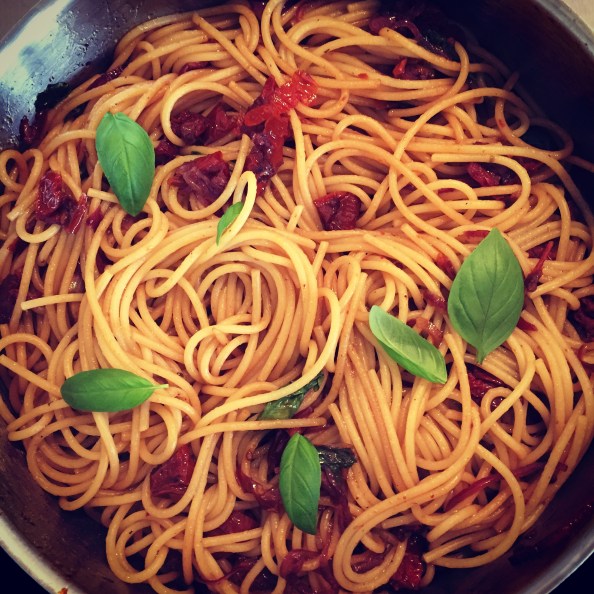
IMG_3425


It was Jamie Oliver’s spaghetti with sun-dried tomatoes, red onion, balsamic and basil and brilliantly quick and easy to make.  I needed to use up the tomatoes in a jar I’d opened a few weeks earlier.  It says to consume them within 7 days of opening but I rarely achieve this and don’t think I’ve poisoned anyone yet.

Anyway, here is what you do:

Jamie Oliver’s Spaghetti with Red Onions, Sun-Dried Tomatoes, Balsamic Vinegar and Basil

Ingredients

(serves 4)

  • 450g dried spaghetti
  • 1 red onion, peeled and finely chopped or sliced
  • extra virgin olive oil
  • 2 handfuls of sun-dried tomatoes in oil, chopped
  • 3 tbsps balsamic vinegar
  • salt and freshly ground black pepper
  • 2 handfuls of basil, torn
  • Parmesan or pecorino cheese, grated, to serve

Method

  • Cook the spaghetti in salted boiling water until al dente
  • While doing this, slowly fry the onion in a couple of lugs (Jamie’s word) for a few minutes (in the simmering oven if you like) until soft and tender
  • Stir in the tomatoes and balsamic and throw in your drained pasta
  • Season and toss together with the basil
  • Serve with the grated cheese

I adore fresh basil and at this time of year I keep a pot of it, bought from the supermarket, on my kitchen window sill and it does very well, as long as I keep it watered.

IMG_3364


Fricassée of Chicken with Tarragon


IMG_4660

This morning I tweeted a line I’d read in the Sunday Times about the Sunday roast being on its way out but that this wasn’t the case in my house.  Wonderfully, the replies I received confirmed that my family is not the exception.  It doesn’t have to be eaten at lunchtime (everyone’s Sundays are busy) but I believe it’s a ritual and tradition worth preserving.

When I was a student and sharing a flat with three friends, where cooking was concerned we had the typical student repertoire of the era, comprising 1001 things to do with mince. But believe it or not, one of our staples was also chicken fricassée.  I’m afraid I can’t remember the recipe in detail but it wasn’t like the dish I made for Sunday lunch today. Our student recipe involved sautéeing pieces of chicken and mushrooms and then adding a little flour, stock and milk (and possibly some cream) to make a white sauce.  We used to serve it with rice.

The origin of the term “fricassée” is French, possibly from “frire” (to fry) and “casser” (to break in pieces), which might explain why all the fricassée recipes I found in a quick Google search this afternoon used chicken pieces rather than a whole bird.  The one I made for lunch today, based on this recipe by Michel Roux which I read in the Times during the week, is the only one I’ve seen which involves roasting a whole chicken.  (Apologies if you’re not a Times subscriber and the article is behind the paywall.)

Anyway, we really enjoyed it; the tarragon sauce is delicious.  Sometimes it’s good to return to a simple classic.  We don’t need always to be finding the next fashionable thing to cook.

I made changes to the Roux recipe; very brave of me, I thought, considering his chef’s credentials and renown, but I honestly didn’t think we needed quite that much cream and also, when you have a roasting oven as hot as the Aga’s, why would you need to brown the chicken before putting it in the oven?

Ingredients

  • 1 whole chicken (mine weighed 2kg)
  • Butter
  • 3 shallots
  • Tarragon vinegar (I didn’t have any so used good quality white wine vinegar)
  • About 100ml white wine
  • About 100ml chicken stock
  • About 150ml double cream
  • Handful of tarragon leaves (adjust amount according to your preference)

Method

  • Place the chicken in a roasting tin, spread butter all over it and season.
  • Roast in the roasting oven for about 1 hour and 20 minutes, basting a couple of times during cooking.  I placed mine on the rack on the third set of rungs for the first 20 minutes, then moved the rack to the bottom of the oven with the tin on the fourth set of rungs.  The cooking time will obviously depend on the weight of your chicken.
  • Remove the chicken, place on a dish and leave to rest (perhaps on the warming plate of your Aga)
  • Pour off most of the fat, add a knob of butter and sweat the shallots gently for about 5 minutes.  Add 1tbsp vinegar and the white wine and let it bubble up for a few minutes.  At this stage I poured everything into a small saucepan: easier than continuing in the roasting tin.
  • Add the chicken stock and boil until reduced a little.  Add the cream and repeat.  Check for seasoning.  Add the tarragon leaves at the last minute.  Pour into a jug for serving.  We ate our fricassée with new potatoes, broccoli and carrots.


Casseroles

IMG_2078


Spring was definitely in the air last weekend.  It was still chilly, especially in the early morning and evening, but when the sun was shining one could actually feel the heat from it.  Early Spring blossom has started to appear on the trees in Bristol and the daffodils are very much in flower.  So it might seem odd that I chose to cook rather wintry, comfort food dishes, but I thought I’d better get them in before temperatures really do rise.


Lancashire Hotpot

My husband says I can’t possibly write a post about this meal because we didn’t take a photo of it, but, with apologies for the lack of illustration, I’ve decided to do it anyway.  It was a success and the ideal thing to cook last Saturday when I had plenty of time in the morning but wanted to watch England play Wales in a crucial Six Nations rugby match in the afternoon.  Honestly, as you will see, this hotpot is more or less just an assembly job.  While I was preparing it I managed to keep an eye on the Italy v Ireland match.

For the ingredients, I more or less followed Felicity Cloake again and make no apologies for that.  Here is what I did.

Ingredients

(Serves 4)

  • 6 lamb cutlets
  • 400g diced lamb shoulder
  • Flour, salt and pepper
  • 3-4 large, floury potatoes
  • 2 sprigs thyme
  • 2 onions, sliced
  • 1 bay leaf
  • 300ml stock (Felicity says lamb stock, but I used a homemade chicken one because that’s what I had in the fridge, and it was fine.)
  • 20g melted butter, plus extra to grease.

Method

  • Dust the meat with the flour and seasoning.  Peel and slice the potatoes thinly.
  • Butter a casserole which has a lid.
  • Put a layer of overlapping potato slices in the bottom of the casserole, season them and sprinkle with a little thyme.
  • Put the meat and bay leaf on top, followed by the onions and some more seasoning.
  • Top with the remaining potatoes, overlapping them again.  Season these and pour on the stock, which should not come above the topping.
  • Brush the potatoes with the melted butter.
  • Put the lid on and place the casserole in the simmering oven.  Cook for 4-6 hours.
  • Thirty minutes before serving, remove the lid and transfer to the roasting oven to brown the potatoes.

I placed it in the oven at about 2pm and then all I had to do when we were ready to eat was steam some carrots (in the simmering oven of course) and cook some cabbage.


IMG_2565


By the way, for afternoon tea on the sofa, in front of the England v Wales match, we had buttered slices of this delicious “hot cross” fruit loaf which I’d bought in the morning from the Bordeaux Quay stall at Whiteladies Road Market.


Simple Stroganoff

This beef stroganoff, based on Delia Smith’s recipe, has the flavours of “proper” stroganoff but the advantage that it can be made ahead instead of at the last minute; it’s ideally suited to Aga cooking.

Ingredients

(Serves 4 people)

  • 700g fairly lean braising beef
  • 2 onions, sliced
  • 50g butter
  • 275 ml dry white wine
  • 250g mushrooms, sliced if large
  • 250ml sour cream
  • Freshly grated nutmeg
  • Salt and freshly milled black pepper

Method

  • Cut the meat into thin strips, about 5mm wide and no more than 6cm long.
  • Melt the butter in a casserole and soften the onion in it in the simmering oven for about 15 minutes.  Remove to a plate with a slotted spoon.
  • Place the casserole on the boiling plate and brown the beef in batches.
  • Once the meat is browned, move the casserole to the simmering plate and return the beef and onion to it.  Season and pour in the wine.
  • Bring to simmering point, put on the lid and let it cook in the simmering oven for 3-4 hours.
  • An hour before you want to eat, stir in the mushrooms, cover and return it to the oven.
  • Taste to check seasoning, stir in the sour cream with a good grating of nutmeg.  Don’t let the cream boil.
  • Serve with plain boiled rice and perhaps some broccoli or a green salad.

Depending on the weather, perhaps my next posts will move on to lighter, fresher dishes.