Chicken and Sweet Potatoes with Miso, Ginger and Spring Onions

Chicken and Sweet Potatoes with Miso, Ginger and Spring Onions


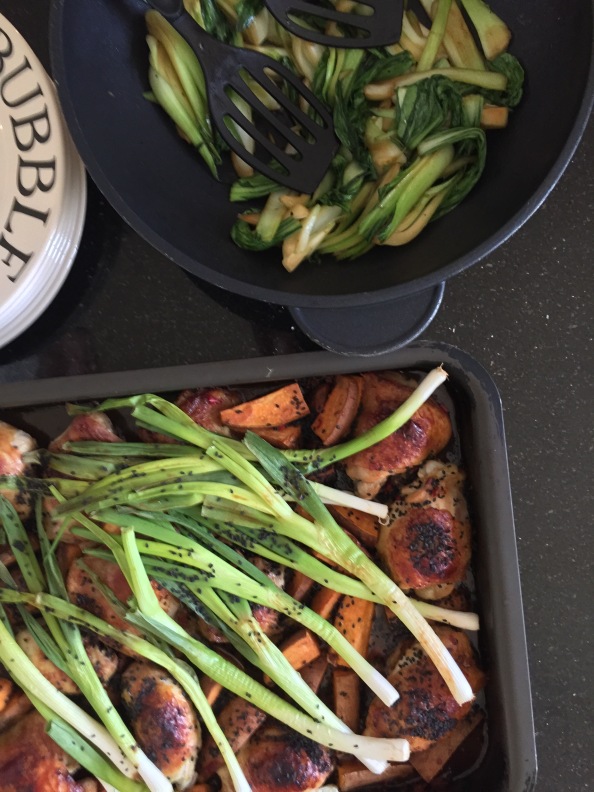
Another of my Easter weekend dishes was this simple chicken traybake, which is also a Diana Henry recipe. It appeared in the Telegraph’s Stella magazine a few weeks ago. I tried it then and knew my family would like it. It’s perfectly suited to Aga cooking.

Ingredients

For 4-6 people, depending on hunger levels and the size of the chicken thighs

  • 8 chicken thighs
  • 700g sweet potatoes, washed and cut into wedges
  • 2½ tbsp white miso
  • 1 ½ tbsp honey or maple syrup
  • 2 tbsp rice wine
  • 1 tbsp dark soy sauce
  • 2.5cm chunk ginger root, peeled and grated or finely chopped
  • 3 cloves garlic, crushed
  • 1 red chilli, halved and finely chopped (use the seeds for extra heat)
  • 12-18 spring onions
  • 3 tsp black or toasted white sesame seeds (or a mixture of the two)

For the final basting

  • 1 tbsp white miso
  • 1 tbsp honey or maple syrup
  • ½ tbsp dark soy sauce
  • ½ tbsp rice wine

Method

Pre-heat conventional oven to 190ºC/gas mark 5

  • Place the thighs in a large roasting tin with the sweet potato wedges (they should be able to lie in a single layer)
  • Mix together everything else except the spring onions and sesame seeds. Pour this over the chicken and sweet potatoes, turning everything over so the ingredients are well coated, finishing with the chicken skin-side up
  • Roast for 45 minutes at the top of the roasting oven, basting every so often, and turning the wedges over
  • Mix the final basting ingredients together and about 15 minutes before the end of cooking time, take the tin out of the oven and pour them over, adding the spring onions at the same time. They should become soft and slightly charred
  • When cooked, sprinkle with the sesame seeds and serve
  • I served ours with pak choi stir-fried in a little groundnut oil with black pepper and soy sauce

IMG_4483


Aubergine and Pea Curry

singin-in-the-rain-7438_1

So that’s it for another year and we can get back to normal, whatever “normal” is. The tree has been taken down and is currently awaiting collection in our front garden; all the decorations have been stored away in the spare room cupboard; and Sons 1 and 2 have returned to work, in Cambridge and London respectively. It was so lovely to have them at home, sometimes with and sometimes without the girlfriend of one and  the fiancée of the other, and although I should be used to it, I always feel a little sad when they’ve gone; not too sad, mind, because, as my mother says, if your children are happy to leave home, then you have probably done a good job as a parent. Son 3 stayed on for an extra couple of days which softened the blow, as much for his younger brother as for their parents. We all love films but Son 3 is the proper film buff of the family and at his suggestion we sat down on Monday evening to watch Singin’ in the Rain. I hadn’t seen it for years and had forgotten just how marvellous it is and what a wonderful actress the late Debbie Reynolds was: RIP. He returned to London with his dad yesterday, leaving youngest son and me, and Granny in her flat downstairs, in a very quiet house until the weekend.

Before he left I borrowed one of his Christmas presents to make supper: the book Fresh India by Meera Sodha, which is on the bestseller lists. Having eaten so much meat over Christmas we were all craving meat-free dishes and the aubergine and pea curry fitted the bill. The last thing I need is another cookbook but if this recipe is anything to go by, I might be adding this book to my birthday wish list.

Aubergine and Pea Curry

  • 5 tbps rapeseed oil
  • 1 teaspoon cumin seeds
  • 2 large onions finely chopped
  • 6 cloves of garlic, crushed
  • 4 large ripe tomatoes, chopped
  • 1 1/2 tbsps tomato purée
  • 1 1/2 level tsps salt
  • 1 1/4 tsps chilli powder (unless like mine, yours is very hot, in which case use less)
  • 1/2 teaspoon ground turmeric
  • 1 teaspoon sugar
  • 4 medium aubergines 1.2kg, chopped into 3cm cubes
  • 100g (I used 200g) peas (fresh or defrosted)
  • Put the oil in a wide-bottomed lidded pan on the simmering plate (conventional hob: medium heat). Once hot, add the cumin seeds and stir for 30 seconds. Add the onions and stir to coat in the oil. Cook (in the simmering oven) for 15-30 minutes until translucent but not brown.  Add the garlic and stir-fry for a couple of minutes
  • Add the tomatoes and purée and cover with a lid. Leave to cook for 5 minutes (or longer in the simmering oven), then add the salt, chilli powder, turmeric and sugar and cook for a further couple of minutes
  • Now add the aubergines, coating the pieces with the masala, pop the lid back on the pan and cook for around 10 minutes (or longer in the simmering oven). You want the aubergines to be tender and soft with little or no water running from them. If they’re watery or not yet tender, they may need another few minutes’ cooking
  • When they’re cooked, add the peas and cook for a couple of minutes
  • Serve with hot chapattis or plain boiled Basmati rice

NB:

  • I used one of those large round aubergines from Natoora. It weighed 620g and I was worried it would not be enough but it was plenty. Am therefore a little baffled by the aubergine quantity recommended in the book. Would it not have led to a very dry curry?
  • Also: I only used 5 cloves of garlic and 1 large onion.


Apologies that I don’t have a photo of this dish (but then nor does the book!). Instead here are a few photos of our Christmas.


Mince Pies

This post is not about telling you how to make mince pies.  To be perfectly honest, as I may have mentioned before, I don’t rate my pastry-making skills and would not presume to pass on any tips, because you are probably all much better at it than me.

That is not to say that I don’t enjoy having a go.  What is more, there’s nothing like making mince pies for getting into the festive spirit and family and friends do appreciate homemade ones.  One of the reasons I’ve made a few in the last week is that I found a big jar of Waitrose mincemeat in my cupboard with a “best before” date of December 2016.  You see?  I don’t even make my own mincemeat!

For the pastry I use this excellent Xanthe Clay recipe.  Sometimes I make “closed” pies (see above) and sometimes I cut out pastry stars to place on top (see below).  I always brush with egg and sprinkle with caster sugar.  I fancy making some with an almond crumble topping one day.  I bought some like that at Bristol’s wonderful Hart’s Bakery yesterday and would love to try to emulate them.  But that’s for another day.

In the Aga

Mince pies bake very quickly in the Aga roasting oven.  Place your tray of pies on the grid shelf on the fourth rung of the oven.  They will be done in 15 minutes at the most.  The oven is hotter at the back and on the side nearest the centre, so I turn the tray round halfway through the cooking time.


Norwegian Bløtkake

fullsizerender-2

This traditional Norwegian celebration cake (translation: soft cake) is part of my childhood in a way that no other food is. My grandmother, aunts, and mother all baked it regularly when I was growing up and then my mother passed the recipe on to me. Nowadays when we go on holiday to Norway, it’s my cousins who make the bløtkake and no doubt they have passed the recipe down to their children as I will to mine.

My mother is a great cook and loved introducing her British friends to Norwegian specialities, but when she was first married to my (English) father she also learnt to do an excellent Sunday roast and many other British recipes. She would make a bløtkake for our birthdays and if friends were coming round. For a few years she ran a small catering firm specialising in parties and weddings, and this cake was probably what her customers requested the most. I can remember helping her with deliveries sometimes which involved me sitting in the passenger seat of her car with the cake in a container on my lap, hoping we didn’t have to brake suddenly.

The cake is not complicated or difficult to make. It uses a fatless sponge so you needn’t feel guilty about the amount of cream required to make this cake delicious and special. I made it recently for my youngest son’s 18th birthday.

Ingredients

You will need an 8″ or 9″ springform cake tin, very lightly greased and base-lined.

  • 5 large eggs
  • 125g caster sugar
  • 125g self-raising flour
  • 300ml (or more) double or whipping cream
  • Fruit: strawberries, raspberries, blueberries or banana or combinations of these. I’m sure you will come up with other wonderful fruit ideas, depending on the season. The one above was a mixture of raspberries and blueberries. I also can’t give you quantities but I’m sure you’ll manage
  • Juice or milk for moistening the sponge

Method

  • Pre-heat a conventional oven to 150ºC
  • Whisk the eggs and sugar (ideally in a mixer or using an electric hand whisk) for 8-10 minutes (depending on the power of your whisk) until thick and very pale in colour. When you lift the whisk the mixture will leave a trail like a ribbon
  • Then fold in the flour; do this gently to keep in as much air as possible
  • Pour the mixture into your prepared tin and bake in the baking oven (see above for conventional oven temp) for about 25-30 minutes. Check it at 20 minutes and maybe turn it round so the other “side” is nearer to the back. If using a conventional oven, don’t even think about opening the door until it’s been in for 20 minutes. It is done if it springs back when pressed down gently with your finger
  • Cool on a rack for at least 10 minutes before turning it out of the tin. Leave it to cool upside down
  • When the cake is cold slice through the middle horizontally so you have two pieces. Even better, slice it into three layers.  In fact, I wish I’d done this for my son’s cake and will definitely do it next time. It makes a more impressive, moist and luscious cake. You may need more cream but given it’s a cake based on having lashings of cream, who’s going to quibble about that?
  • You need to moisten the sponge layers before filling the cake. You can use juice from the fruit (I had frozen raspberries which released a lot of juice after defrosting); or a little diluted elderflower cordial; or milk. We’re only talking about a couple of dessert spoonfuls
  • Whip the cream
  • Sandwich the cake together with the cream and fruit. Be generous with both
  • Finally, spread the rest of the whipped cream thickly over the whole cake and decorate with a little more fruit
  • It is customary to cut a circle in the middle of the cake and slice it from there. If it’s a birthday cake, the round piece can be saved for the birthday boy or girl

One more thing: if you don’t eat the whole cake at first sitting, and it is definitely best when fresh, make sure you store it in the fridge.

Update

My mother has read this post and passed on a tip which finishes the cake off nicely: keep back a little cream for piping round the bottom. As you can see from the photos, mine has a bit of a gap and would have been improved hugely if I had done this. What can I say, except I clearly haven’t inherited my mother’s knack for presentation.

Norwegian Apple Cake

Norwegian Apple Cake


In this post a year ago I mentioned my Norwegian grandmother’s apple cake. It has become a Hardy family tradition to have it on Christmas Eve, but that doesn’t stop us having it at other times of the year. I have vivid memories of evening coffee time at my grandparents’ house in Oslo when cake would often be served.

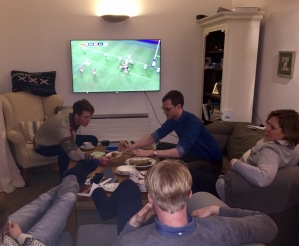
I made the Norwegian apple cake this weekend for second son’s birthday. It’s not a typical birthday cake but I don’t think that matters. We managed to get his brothers to come along and gathered in London for tea and cake which we consumed while watching the England v Wales Six Nations rugby match. img_6492

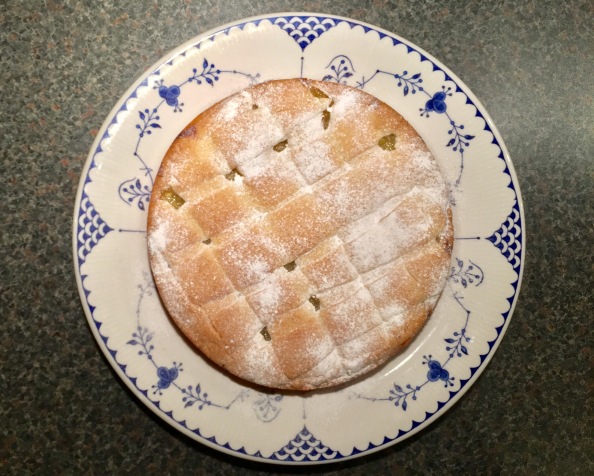
I don’t think my grandmother, who is no longer with us, would mind if I gave you the recipe.  It’s extremely easy to make. You can keep it just as it is, or add cinnamon to the apples or sprinkle some flaked almonds over it, or both.

Norwegian Apple Cake

You will need a 20cm/8″ springform cake tin, greased and base-lined with greaseproof paper or bake-o-glide.

Conventional oven: pre-heat to 160º-170ºC

Ingredients

  • 4 Bramley apples
  • 125g plus 1 tbsp caster sugar
  • 125g butter, softened
  • 240g self-raising flour
  • 1 large egg

Method

  • Peel, core and slice the apples and place the slices in a bowl with the juice of a lemon to stop them going brown. Add the tablespoon of sugar
  • Place the apples in a saucepan with a little water, let’s say 3mm deep. Cook them for a minutes on the Aga simmering plate or your hob, giving them the occasional stir with a wooden spoon. When they’re all soft, remove from the heat and leave to cool
  • Make your cake batter by placing the sugar, butter, flour and egg in a bowl and beating the mixture. I use my electric mixer
  • Press two thirds of this mixture into the base of your prepared tinimg_4305
  • Then spoon the stewed apples over this but not right up to the edge. If you feel you have too much apple mixture (after all, Bramleys vary in size) save some (freeze it if necessary) to have with roast pork at a later date
  • On a floured surface very gently roll out the remaining third of the batter and then cut it into strips about 1.5cms wide
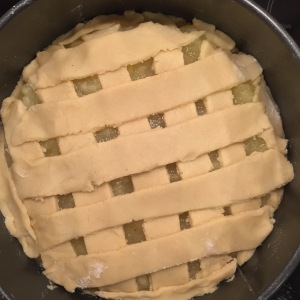
  • Arrange these strips in a lattice pattern over your cake. You don’t have to make a complicated over and under pattern. The dough is very soft and the strips might break as you pick them up. img_4306Don’t worry: you can just patch them together as you place them. As you can see from the photos, mine does not look remotely professional
  • Bake your cake until golden brown. You can’t test it because of the apples.  I find it usually takes between 35 and 45 minutes.  I start checking it at about 25.
  • You can serve it warm (but not piping hot) or at room temperature, dusted with icing sugar and cinnamon. I’m not a cream person but this cake really is best served with a dollop of lightly whipped cream.img_4319

Green Beans And Vinaigrette


Look away now if you don’t approve of buying those packs of fine green beans imported from Kenya and Zambia because of the air miles involved in getting them here.  We like them in this house so I do buy them.  In the last few weeks Waitrose has been stocking homegrown ones which seem a little fatter but are full of flavour.

One of my favourite ways of serving them in the summer is as a salad in a classic vinaigrette.  I cook the beans, drain them, plunge them in cold water so they retain their colour and drain them again.  And then I toss them in the vinaigrette which I make as follows:

  • Put a teaspoon of Dijon mustard in your salad bowl
  • Add a little salt, freshly ground black pepper and 1/2 tsp of sugar
  • Add 1 tbsp of white wine vinegar
  • Using a small whisk mix this a little and then slowly pour on extra virgin olive oil, continuing to whisk all the time.  I cannot tell you how much oil I use.  It emulsifies gradually and somehow I just know when it’s enough.  I taste it too of course: if it’s still very tart I might add a little more oil

You may prefer to make your dressing in a jug or small bowl, or in a jam jar by placing all the ingredients in it, putting on the lid and giving it a shake.  I find it easier to make it in the salad bowl and have got used to knowing how much dressing I need for the amount of salad I’m making.  Sometimes I vary it; for example, I might omit the mustard and add red wine vinegar instead of white, a little crushed garlic and some chopped flat leaf parsley; or, to avoid a too strong taste of raw garlic, I’ll peel and flatten a clove slightly and leave this in the dressing but remove it when it’s time to serve the salad.  This provides a mere hint of garlic flavour.

Making the dressing in the salad bowl takes me back to one of my first stays in France as a teenager.  I was 15 and went to stay with the family of Sophie, whom we had hosted the previous year.  Sophie lived in the heart of Burgundy country in a stunningly beautiful house which seemed to me like half a chateau.  She must have found our house in England very small.  It was a very hot summer and all meals were taken outside with rarely fewer than about ten people at each sitting.  Sophie’s father ran his own business and always came home for lunch, sometimes bringing a couple of colleagues with him.  We girls occasionally helped their maid, Lily, in the kitchen and that is where I learnt to make vinaigrette.  Another memory is Sophie’s father taking his lunchtime red wine (Burgundy, obviously) with ice cubes.  My father was astonished when I told him this.  I returned from that holiday with much improved French, new friends and feeling very worldly wise.

Horseradish Sauce

For the first time in years I am alone on a Sunday.  Well, not completely alone since my mother-in-law is here, in her flat on the bottom floor of our house.  She’s worried that I’ve stayed behind because of her but while it’s true that she’s frail and we don’t like to leave her on her own, that’s not the case.  It was my choice and I’m enjoying the chance to catch my breath; I’ve never minded my own company.  My husband is on his annual Scottish fishing trip and youngest son’s in Cornwall with his brother and fiancée, staying with her family, and I’m just happy if everyone’s doing what they want to do.   I’ve mentioned before that we usually have Sunday lunch or supper with Granny, but she and I agreed there didn’t seem much point in doing a roast today.  I’m finding it quite liberating to be able to eat what and when I like.

So, although I’m not roasting anything myself today, I thought I’d tell you about this delicious homemade horseradish sauce I made last Sunday when there were six of us round the table for roast beef.  The same friends who gave us their homegrown courgettes had given us a piece of horseradish from their garden.  I’d never used it before and was delighted with this creamy, fresh-tasting sauce.

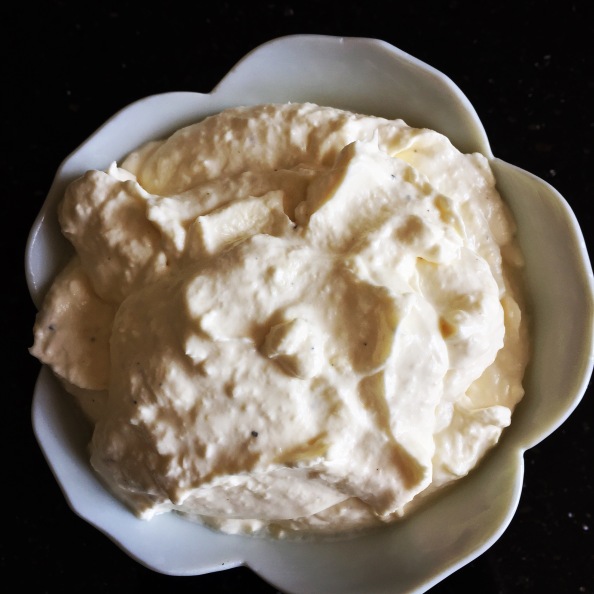
All you do is grate about 15g (more if you like extra heat) of horseradish and soak it in two tablespoons of hot water; drain, then mix it with one tablespoon of white wine vinegar, a pinch of mustard powder, salt and pepper and 150ml of lightly whipped double cream.

IMG_3654

Glazed Lemon Cake


IMG_1268

The cake

Parliament has gone into recess, a new Prime Minister is in place and the schools have broken up, so it’s probably not too soon to say that the political scene will calm down a little following the tumultuous four weeks since the EU Referendum result.  For this news junkie it will mean more time for neglected chores but more importantly, even though we’re not going away on holiday this year, for doing nice things with friends and family.

And now is when it starts.  It’s the time of year again when I make a birthday cake for my eldest son, who is 29 today, which is hard to believe.  For the last three years he’s shared his birthday with Prince George.  Two of his brothers and I celebrated his 26th birthday over lunch in a Cambridge restaurant and I recall that they were irritated with me because I kept glancing at my phone to see if there were any news alerts about the royal baby.  It had been announced earlier that morning that the Duchess of Cambridge had gone into labour.

I can’t remember if I made a birthday cake on that occasion, but I like to bake one for all my boys’ birthdays if it’s practical.  The eldest was on an expedition in Ecuador for his seventeenth birthday and there’s a great photo of him waking up in his sleeping bag to be presented by his friends with a cupcake bearing a single candle.  He lives in Cambridge and a couple of years ago, because we weren’t going to manage to meet up around the big day, I ordered him two cakes from that great Cambridge institution, Fitzbillies.  (If you ever visit, you have to try their Chelsea Buns.)  I couldn’t decide between the chocolate and the carrot so bought both (in the smallest size).  Extravagant, but I knew he’d be sharing them with friends.

When he was small I wasn’t really into baking and anyway, was working full-time and didn’t feel I had much time in my life for it.  But I did usually manage to make some sort of sponge cake and get my husband, who is more creative than me, to cut it up and shape it into whatever the boy was into that particular year, ready for me to slather it in buttercream.  For example, we made a train when he was two and a football pitch when he was five.

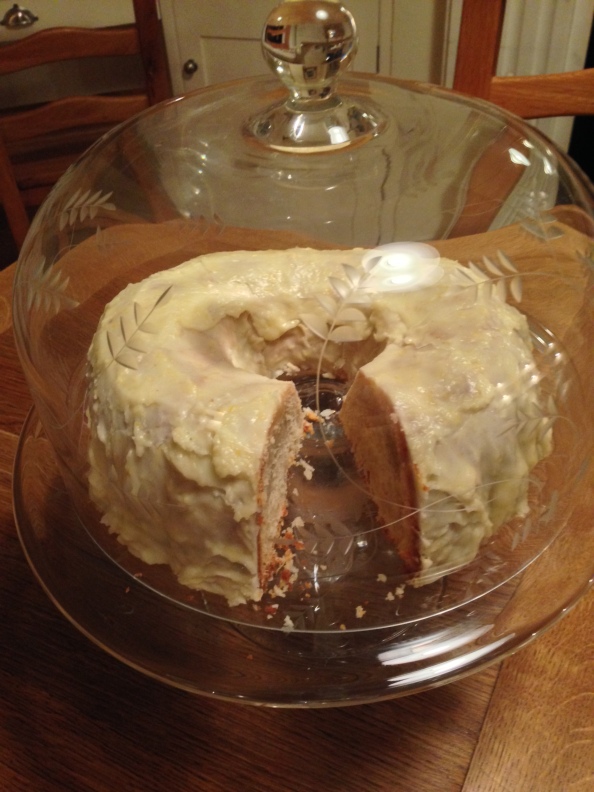
This year, not for the first time, I’ve made his favourite Glazed Lemon Cake from the Silver Palate Cookbook.  It’s not particularly quick to make, what with seven lemons to zest and a lengthy icing process, but worth it for an occasion and one cake goes a long way and keeps well in an airtight container.

We are all meeting up in London this weekend to celebrate the birthday.  I will be travelling up alone on the train and have to work out a way to get the cake there without damaging it.  I know it freezes well so I’ve decided to freeze it and let it gradually thaw during the journey.  That way it will be very fresh by teatime and also not too squishy while in transit.

Glazed Lemon Cake

You will need a bundt tin, greased, or a tube tin, as it’s called in The Silver Palate Cookbook, which is American.

Conventional oven: pre-heat to 160ºC

You want the lemon zest to be very finely grated.  I find a Microplane grater is best for this.

Ingredients

  • 7 lemons (you’ll need all the zest but the juice of only 3 or 4)
  • 225g unsalted butter
  • 400g granulated sugar
  • 3 eggs
  • 375g plain flour
  • 1/2 tsp baking powder
  • 1/2 tsp salt
  • 284ml buttermilk
  • 2 tightly packed tbsps grated lemon zest
  • 2 tbsps fresh lemon juice
  • Lemon icing: see below

Method

  • Cream butter and sugar until light and fluffy. Beat in the eggs, one at a time, blending well after each addition
  • Sift together flour, baking powder and salt. Stir dry ingredients into egg mixture alternately with buttermilk, beginning and ending with dry ingredients. Add lemon zest and juice
  • in Full disclosure: as you know, I’m a fan of the all-in-one method and it works for this cake too. Mix thoroughly all the ingredients except the zest and juice and fold these in at the end
  • Pour batter into the prepared tin. Set on the middle rack of a pre-heated conventional oven or on the rack on the bottom rung in the Aga baking oven. Bake for 1 hour 5 minutes (conventional) or slightly less time in the Aga
  • For Aga baking I check the cake after 30 minutes and turn it, and then check it every 10 minutes to make sure the top isn’t burnt. It shouldn’t take more than 1 hour in total. It’s done when a skewer comes out clean

Lemon Icing

  • 450g icing sugar
  • 113g unsalted butter, softened
  • 3 tightly packed tbsps grated lemon zest
  • Juice of about 2 lemons
  • Place the sugar, butter and about half the juice in a mixing bowl and gradually blend them using a handheld mixer. When smooth, mix in the remaining juice and zest. Note: this icing is a lot runnier than buttercream icing.
  • When the cake has been out of the oven for about 10 minutes, gently pierce it all over using the narrow end of a chopstick. Spoon over about a third of the icing and allow it to sink in for about 5 minutes before turning out the cake onto a cooling rack
  • Pierce the other side of the cake all over and begin spooning over the remaining icing. It will slide down the sides and end up on your board/work surface but you just have to keep scooping it up and pouring it over the top again. This is the boring, lengthy bit: it could take half an hour until the icing has stopped sliding off the cake and  has mostly sunk into it. See slide show below:


This slideshow requires JavaScript.

Chocolate and Gout


IMG_2072

I’m hoping the first part of the title of this post drew you in enough for you not to be put off by the second part.

I’ve always loved chocolate: the taste of it and the texture; and the undoubted cocoa solids and caffeine-induced hit it gives.  In the past, to prove to myself that I have a modicum of willpower and I’m not a complete chocoholic, I’ve given it up for Lent.

Today (Easter Sunday) I ate chocolate for the first time in several weeks, since before the start of Lent in fact.  Tomorrow I will be giving it up again, but for health reasons.  I’ve been getting joint pain for quite a few years now.  My orthopaedic surgeon husband says I have osteoarthritis and that I’ve inherited this from my father and grandmother.  They never spoke of it, but with hindsight it was obvious they suffered from it too.  My father attributed any aches and pains of his to rugby injuries which had never been properly treated, but that was probably only part of the story.

In recent years my husband has been sending an increasing number of his patients, who report to him with knee pain and a history of other joint problems, for blood tests to ascertain their uric acid levels.  If levels with a single test are high it means that the patient has been suffering from episodes of gout.

Gout is inflammation of joints and soft tissues due to crystallisation of uric acid within a joint that has been predisposed to this deposition by previous injury.  His new secretary, who used to work in General Practice, cannot believe how frequently he spots it in his patients.

It’s very useful being married to a doctor but, quite rightly, they do not like to treat family members.  The way it works in our family is: someone describes their ailment and my husband decides whether they need to a) see the GP, b) go to A&E or c) go directly to a colleague.  It means we probably spent a lot less time in GP waiting rooms when the children were small than most parents.  Anyway, having had so many patients come back with a positive test for gout, my husband suggested that I ask my GP to order a blood test for me, because if my uric acid levels were high, or near the upper limit of normal, something could be done about it and it would reduce the episodes of pain I’m experiencing in my hands and feet.

The blood test came back as “normal” but my levels were at the upper end of the range and my husband said it would only take one meal of high purine foods to tip me over the edge.

Purines from foods and tissue turnover are the precursor of uric acid which some people are unable to excrete, especially when exposed to our rich Western diet.

He gave me a very useful chart listing almost every food you can think of with those high in purines at the top.  At the very top of the chart the substance with by far the highest purine levels was theobromine, which is found in cocoa.  I jokingly said to my husband that in that case I’d give up chocolate and solve the problem.  To my surprise he agreed.  So I stopped eating chocolate overnight and after six weeks went back for another blood test and, to my astonishment, my uric acid levels had dropped considerably.  My symptoms haven’t changed but my husband says that will take at least 6-12 months.

I have written this post to raise awareness.  Not very much appears to be known about gout, but 1 in 40 of us have it and many suffer without a confirmed diagnosis.  It seems to affect young men and post menopausal women.  My GP did not think it necessary to test my uric acid levels but was happy to do it when asked.

I will miss chocolate, but will allow myself a small amount from time to time.  It seemed easier to give it up than to have to think about purines every time I cook a meal for the family.

IMG_0737

Braised Sausages and Lentils

When I read this article about home comfort eating in The Times the other week, I couldn’t wait to make the braised sausages and lentils recipe.  It seemed so perfectly suited to Aga cooking and simple to make, but on my first attempt I ended up with far too much liquid in the pan, even after the lentils were thoroughly cooked and tender.  I remembered the important Aga rule always to use less liquid than the recipe states, but I obviously didn’t reduce the quantities by enough.  The resultant dish was delicious though, and I resolved to have another go very soon.

I was reminded of it last weekend which we spent away, leaving my sisters-in-law to look after the two elderly ladies of the household: my 91 year old mum-in-law and our 13 year old (also 91 in dog years!) spaniel, Rosie.Dog in Grass

It was a special weekend because our son W and his fiancée, K, were hosting a lunch for the two families to celebrate their engagement.  This took place at our flat in London where they are currently living.  They served up a veritable feast of ham hocks, roast chicken and gratin savoyard with leeks.  There were also braised puy lentils, a delicious winter slaw made with red cabbage, celeriac and sprouts and a mixed green salad.  For pudding K made tiramisù and her younger sister a blueberry and cinnamon cake.  They probably expected to serve all these dishes buffet-style, but we found that we could seat all fourteen of us at two pushed together tables.

IMG_2498

It was a very happy occasion and a lovely way for us all to get to know each other.  We like K’s family very much and I feel fortunate that we’ll have in-laws that we get on with.  Knowing that we would be eating well in the evening too, I was quite restrained and limited myself to a small amount of lunch.  At about 5 o’clock my husband and I left youngest son J with his brothers and future in-laws and headed off to the depths of rural Hampshire to stay with our good friends R and P in their beautiful barn conversion.  R is a superb cook and after a drink by the roaring log fire, we sat down to a dinner of salmon terrine, beef with a fennel and thyme crust, roasted vegetables, and dauphinoise potatoes (by now I was so glad I hadn’t eaten too much at lunchtime).  She also served a deliciously melting chocolate pudding, from a recipe by chef Marcus Wareing.

On Sunday the four of us went for a walk which we enjoyed despite the rain.  IMG_2518It helped us work up an appetite for a delicious lunch of sausages and a bulgar wheat salad (R and I agreed that sausages go so very well with grains or pulses) and this is what jogged my memory and led to me attempting the braised sausage and lentil dish again.
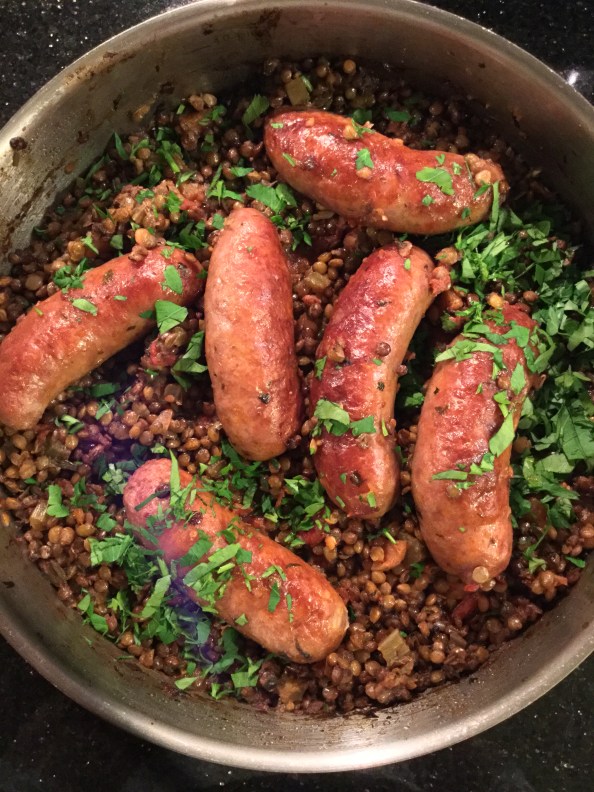
There were only three of us so I reduced the quantities in the Times recipe, but this is one of those dishes where you don’t need to be too precise.  (We had some left over which reheated beautifully for lunch the next day.)  I also adapted the recipe slightly to suit my available ingredients.  This is what I did:

Ingredients

  • 250g puy lentils
  • 4tbsp extra-virgin olive oil
  • 1 onion
  • 1 bay leaf
  • 4 garlic cloves, crushed
  • Pinch dried chilli flakes
  • Large handful of fresh flat leaf parsley, chopped
  • 1 stick celery, diced
  • 1 carrot, diced
  • 1 glass red wine
  • 1 tin whole plum tomatoes, drained
  • 6 good quality pork sausages
  • Chicken stock, approx 300ml, but probably less
  • 1 tbsp balsamic vinegar
  • A couple of handfuls of spinach leaves
  • Salt and pepper

Method

  • Cover the lentils with cold water, bring to the boil on the boiling plate, then simmer for 5 minutes on the simmering plate.  Tip the lentils into a sieve and wash under cold water until cold to the touch.
  • Pour half of the olive oil into a wide, shallow casserole or sauté pan.  Place it on the simmering plate and add the onion, bay leaf and a pinch of salt.  Coat everything in the oil, then cover and cook in the simmering oven for about 15 minutes until the onions are soft but not coloured.
  • Add the dried chilli, some ground black pepper, the parsley, celery and carrot.  Stir, then cook covered in the simmering oven for a further 15 minutes, until soft.
  • Add the garlic, stir, then pour the red wine over the vegetables, bring to the boil on the simmering plate and reduce by two thirds.
  • Add the blanched lentils, whole drained plum tomatoes, chopped up a bit, and place the sausages on top. Then add about 200ml of the chicken stock and bring to the boil.
  • Now you have a choice: if you have lots of time, place it, uncovered, in the simmering oven for a couple of hours, checking the stock level after about an hour and adding more if it’s looking dry, until the lentils are soft.  The problem with this method is your sausages might not brown very well, but 10 minutes in the baking or roasting oven at some point during the cooking should resolve that.  I was in a hurry, so I cooked mine for about an hour in the baking oven (I think the roasting oven would be too hot), turning the sausages over half way through to brown them all over.  I added a little stock during the cooking time but don’t think I used more than 250ml in total, a lot less than the Times recipe specifies.
  • When the lentils are tender and the sausages cooked, move to the simmering plate, add the spinach leaves and allow them to wilt.  Remove from the heat, stir through the rest of the oil and the balsamic vinegar and check the seasoning.
  • To serve, you could sprinkle over a little more chopped parsley.

I hope you enjoy this recipe.  For me, making it was a pleasure because it was so straightforward and – a huge plus – you don’t have to brown the sausages in advance.  Have I mentioned before my dislike of browning meat?  It makes such a mess with fat splashing everywhere, even in my hair, and leaving a thin film of grease on almost every kitchen surface.

IMG_0727